Hiring · August 2, 2026 · 10 min read
AI agent engineer job description template (2026)
A free AI agent engineer job description template for 2026: copy-paste responsibilities, requirements, the AI-fluency section rivals omit, and what to assess.
← Part of The pillars of hiring: what assessments measure
On this page
This page is for the engineering leader or recruiter who has to open a requisition for a title that barely existed two years ago — and who has already noticed that half the applicants describe themselves the same way. An AI agent engineer builds systems where a model acts over many steps: planning, calling tools, handing off, and recovering from its own mistakes, rather than answering once and stopping. The job description is genuinely hard to write, for three reasons at once. The title is new, so there is no settled market boilerplate to lean on. The word everyone reaches for — "agentic" — has become 2026's most rebranded line on a CV, so the description has to filter for the real thing. And the role sits in an awkward place in your org, close to whoever owns reliability, because an agent in production is mostly a reliability problem wearing a clever hat. You need this hire when your agents have started failing in ways an ordinary backend never does, not before. What follows is a copy-paste AI agent engineer job description template, plus the sections every competitor's template leaves out: what to expect of this person's AI fluency, and what you can actually assess behind each requirement.
The AI agent engineer job description template
Copy the sections below and adapt the bracketed placeholders to your company. It is written to read like a spec you can test a candidate against, not a wish-list of technologies. Keep the AI-fluency section — that is the part that separates this from every other template in the field.
About the role
[Company] is hiring an AI agent engineer to design, build and operate the autonomous systems behind [product or workflow]. You will own agents that run in a loop — planning, calling tools, handing off, and recovering from failure — and you will be accountable for what happens when a loop goes wrong, not just when the demo goes right. You will work alongside [reliability / platform / applied-AI] and report to [manager], with the mandate to make our agents bounded, observable and affordable in production.
Responsibilities
- Design the agent's orchestration loop — how it plans, when it calls a tool, how it decides it is finished, and what stops it running forever.
- Bound the blast radius with tool and permission design, so a confident-but-wrong agent can read a record but cannot delete data, message a customer, or spend past a ceiling.
- Design hand-offs between agent and sub-agents, and between agent and human, with a clear contract for what each side is responsible for.
- Build failure recovery — retries that back off, checkpoints so a failed step doesn't restart the whole run, and dead-ends that fail loudly rather than silently.
- Instrument every run with step-level traces of decisions, tool calls and results, so a root cause several steps upstream of the symptom is findable.
- Build evaluation harnesses for multi-step tasks that judge whether the agent reached the right outcome and got there for sound reasons, across many runs.
- Control cost with token budgets, step limits and loop detection, and watch the spend curve for the retries that quietly set money on fire.
- Debug non-deterministic failures in production and drive the fix upstream of where the run fell over.
- Advise the team on when an agent is the wrong tool and a plain deterministic workflow would be cheaper and safer.
Requirements
- Demonstrated experience shipping and operating an autonomous agent in production — not a demo, but a loop that has run against real traffic and failed at least once in a way you had to diagnose.
- Fluency in orchestration-loop design: planning, tool invocation, termination conditions, and loop-and-drift control.
- Hands-on tool and permission design — least-privilege access, sandboxed execution, and irreversible-action routing to a human.
- Experience building evaluation harnesses for multi-step behaviour, not just graded single responses.
- Strong observability instincts for non-deterministic systems: tracing, reproducing intermittent failures, and reading a run backwards from the symptom.
- Cost and reliability engineering judgement — the systems-engineering half of the role, applied to a loop that can amplify its own mistakes.
- Clear reasoning about trade-offs, including the discipline to argue against building an agent when a workflow would do.
Nice to have
- Prior on-call or reliability ownership for a production system with unpredictable load.
- Experience with multi-agent hand-off patterns and human-in-the-loop escalation design.
- Familiarity with the failure modes of retrieval and long-context inputs feeding an agent's decisions.
- A public write-up, post-mortem or talk about an agent that failed and what you changed.
AI fluency expectations
This role is meta: the person builds with and for AI every day, so their own AI fluency is part of the job, not a side skill. State it explicitly.
- Judge model output quality under drift — recognise when a plausible-looking result is wrong before it compounds several steps downstream, and when model behaviour has shifted between versions.
- Design guardrails for non-deterministic behaviour: bounded permissions, verification steps, and human checkpoints on irreversible actions.
- Debug failures that don't reproduce, treating the crash as a lagging indicator and reading the trace upstream to the real cause.
- Delegate to AI tools wisely while working, and verify their output against the real system rather than trusting confident answers.
- Reason about model choice, cost and latency as engineering trade-offs, not as a leaderboard ranking.
What we offer
[Company] offers [compensation range / band placeholder], [equity], and [benefits summary]. You will own [scope] with [level of autonomy], work with [team / stack], and have [learning budget, on-call arrangement, remote or hybrid policy]. Add your genuine differentiators here — real ownership of a new discipline is worth more to this candidate than a perks list.
The AI-fluency section above is the part no ranking job description template in the field currently includes — we checked. For a role whose whole day is spent judging model output and designing around non-determinism, leaving it out is leaving out the job. Keep it in, and phrase the bullets so a candidate could be assessed against them.
How do you adapt this template?
Turn the seniority dial by how much you lean on the word "operated". A senior hire has bounded and instrumented a live agent and can prove it; a mid-level hire has built loops under supervision and is ready to own reliability with a mentor nearby. Cut ruthlessly for scale, keep the evaluation-harness and blast-radius bullets whatever you cut — they are the spine of the role.
For a startup shipping its first agentic feature, trim the multi-agent hand-off and on-call requirements and be honest that a strong AI engineer or a backend engineer with good judgement may cover it for now. For an enterprise running agents against production tools, the sandboxing, permission-design and audit-trail bullets move from nice-to-have to non-negotiable. Either way, write the description around observable behaviours, the way how to write a job description argues — the description should read like something you can test against.
The lines to delete are the ones copied reflexively from legacy engineering job descriptions:
- A specific degree requirement. The strongest people in this discipline are self-taught on a problem that has no degree yet; a degree filter mostly narrows your pool and imports adverse impact.
- "X years of experience with [named agent framework]". The frameworks are younger than the requirement implies, and years with a library measure exposure, not judgement.
- A long tool checklist. Listing every orchestration framework you have heard of invites the exact impostor this role attracts, and tests nothing.
What should you assess instead of trusting the CV?
A CV cannot tell you whether someone has operated an agent in anger or only recorded a demo that happened to work that day. So map each requirement to a capability you can observe, and assess the capability directly. Our public view of what candidate evaluation should measure runs on four scored pillars — cognitive, domain, situational judgement and behavioural — plus AI fluency as a requirement check you set, and this role touches all of them, with unusual weight on the behavioural pillar and the AI fluency check.
- Domain — orchestration, tool-boundary and evaluation-harness design. Assess with a job-shaped task, not a framework quiz.
- Cognitive — reading a failure backwards through a multi-step trace to a cause that isn't where the symptom is.
- Situational judgement — the when-not-to-build-an-agent call, and how they bound an agent with access to real production tools.
- Behavioural — the reliability-first temperament that instruments before it ships and fails loudly on purpose.
- AI fluency — judging model output under drift and delegating to AI while verifying it, watched rather than self-reported.
The single most predictive exercise is a job-shaped work-sample test: a misbehaving agent trace to debug, where the failure surfaced several steps after its actual cause, with AI tools available and the process observed. Run it the way structured interviews prescribe — same task, same materials, same rubric for everyone — and score observable behaviour, not how confident the candidate sounded. The AI Sandbox runs exactly this kind of session with AI tools genuinely available, so you see not just the fix but how they delegate to the model and where they catch it being confidently wrong. For reading those signals cleanly, the 4D framework — Delegation, Description, Discernment, Diligence — is the rubric, and how to assess AI fluency covers the method. For the full hiring process behind this template, from scoping to offer, read how to hire an AI agent engineer; this page is the artefact, that one is the playbook.
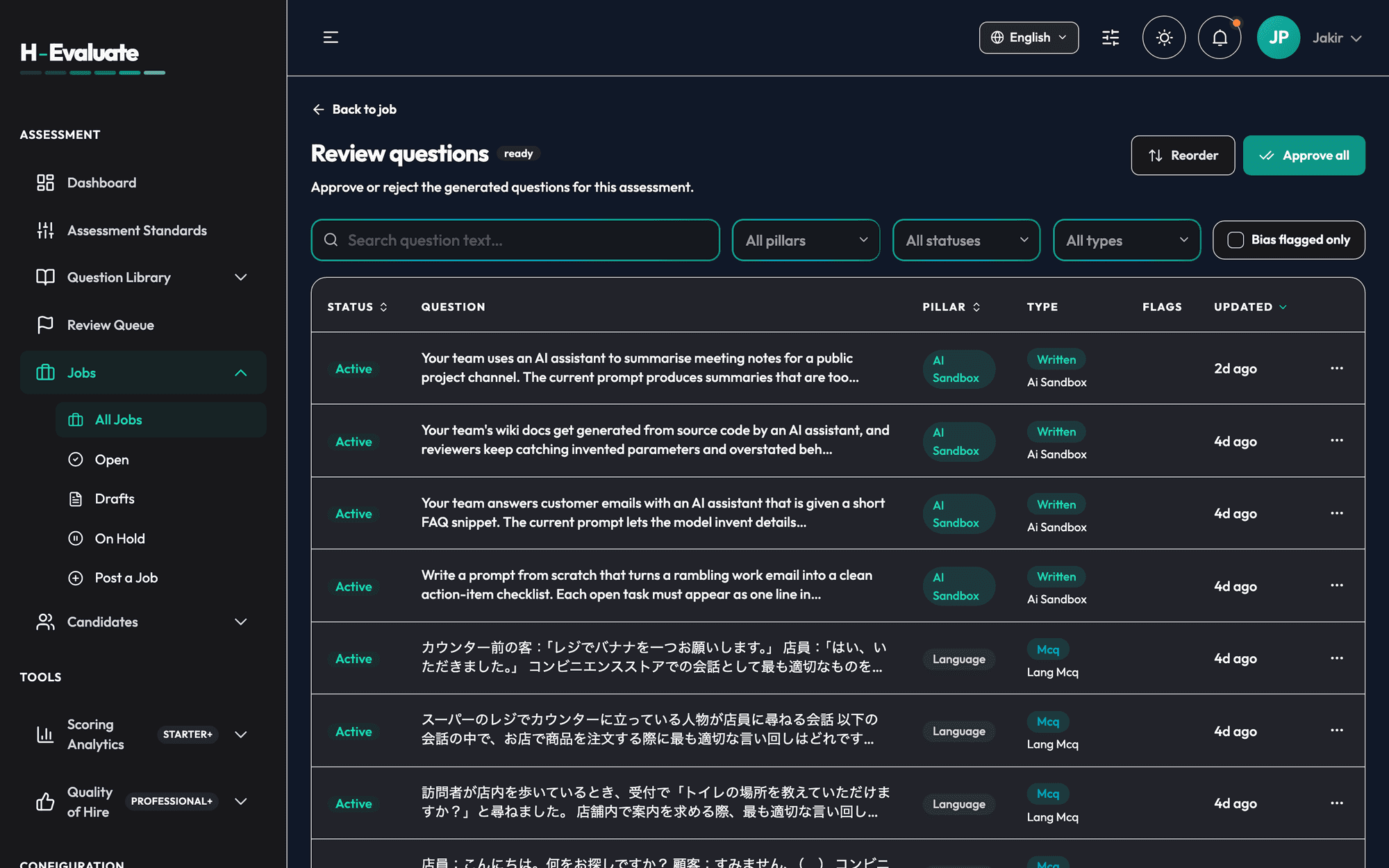
Scored
Checked, never scored
Language
Pass/fail. Below the level you set, the candidate doesn't advance.
AI fluency
Below the minimum, a passing candidate goes to human review.
The scored pillars, weighted to the role (plus the AI Sandbox if enabled), make up the score. Requirement checks sit outside it.
Why is "agentic" the word to distrust on a CV?
"Agentic" is 2026's most rebranded line on a CV. The role is new and in demand, so everyone who once wired a prompt chain together or shipped a thin wrapper around a popular agent library now claims agent engineering. The description above exists partly to filter them out, because the impostor and the real engineer read almost identically on paper. The tell is not whether someone can build an agent — almost anyone can now. The tell is whether they have operated one when it turned on them.
The red flags show up as a pattern in the application, not a single line:
- Framework name-dropping in place of failure stories — five orchestration libraries listed, not one agent they had to debug in production.
- Prompt-chaining described as if it were orchestration. A sequence of model calls stitched together is not a loop that plans, acts, checks and recovers; the difference is the entire job.
- No mention of blast radius, evaluation harnesses, cost, or what happens when the agent is confidently wrong — the parts a demo never forces you to build.
- Wanting to make everything an agent. Someone who has been burned by one will, unprompted, tell you half the things people want to make agentic should stay a plain workflow.
- A portfolio of demos that worked on the day of the recording and no post-mortem of one that didn't.
A fast screen for the real thing: ask the candidate for a time they argued against building an agent, and what it cost them to win or lose that argument. The prompt-chaining hobbyist has no such story. The engineer who has run loops in production has several, and tells them without prompting.
You may not need this role yet. If you cannot name a production agent that currently loops, retries or hands off — and a specific failure it has already caused — you are probably hiring an AI engineer with a fancier title. Scope to the problem you have, not the one on the roadmap slide, and revisit when the failure modes are real.
One more honest note, since we build candidate evaluation for a living and you should discount us accordingly: a template is only as good as what you do after it. The value here is not the bullets — it is that every requirement is written as something assessable, so the description and the assessment are the same document seen twice. Write the job description that way, test against it, and "agentic" on a CV stops being a word you have to take on faith.
The tell isn't whether a candidate can build an agent. Almost anyone can now. The tell is whether they can look at a problem and say, calmly, that it shouldn't be an agent at all — and then debug the one that already is, four steps upstream of where it fell over.
Written by
Aayesha Patel · Co-founder, Hanzomon Inc
Co-founder of Hanzomon. Writes about skills-based hiring, fair assessment and building a better candidate experience.