Hiring · August 2, 2026 · 13 min read
AI fluency interview questions: how to evaluate answers
AI fluency interview questions for the interviewer: 24 questions grouped by competency, what strong and weak answers sound like, and how to score them.
← Part of The pillars of hiring: what assessments measure
On this page
This guide is for the interviewer — the hiring manager or panel member deciding whether a candidate can actually work with AI, not just talk about it. By 2026 nearly every knowledge job runs with an assistant in the loop, which makes AI fluency one of the most predictive things you can evaluate and one of the easiest to fake in a conversation. Here is the uncomfortable part: a flat list of AI fluency interview questions is a leaked exam. Candidates prep with the same assistants they will use on the job, and a memorisable question produces a rehearsed, polished answer that tells you nothing. So this is not a list to read aloud. It is a guide to what strong and weak answers sound like, how to score them consistently, and — the point most lists miss — when to stop asking and start watching the work. Where in the loop do these belong? Early enough to shape your later probes, and always paired with a task, never as the whole assessment.
How do you score interview answers consistently?
Before the questions, the scoring. If you have no rubric, you are rating confidence and jargon — and candidates who sound AI-savvy are not the same as candidates who are. The fix is boring and well-evidenced: a behaviourally-anchored rubric, written before you interview, applied to every candidate identically. This is generic structured-interview practice, not anything proprietary, and it is what turns a fluency stage from a vibe check into a real read.
- Write the anchors first — for each question, define what a 1, a 3 and a 5 answer sounds like before you meet anyone, so you are matching answers to a scale rather than to your mood.
- Ask every candidate the same questions in the same order, so the differences you see are in the candidates, not in how you ran the conversation.
- Anchor to observable behaviour — 'named a specific confident error and how they caught it' scores; 'seemed comfortable with AI' does not.
- Score independently before you discuss — panel drift toward the loudest voice is real, and comparing notes after everyone has committed a number keeps it honest.
- Keep the scale tight — a 1-to-5 rubric with real anchors beats a 10-point scale that invites false precision no one can defend later.
Why does this matter more for AI fluency than for most competencies? The skill is invisible on a résumé — everyone writes 'proficient with AI tools', which could mean a workflow rebuilt around the tools or a copy-paste habit. And the failure mode is quiet: the dangerous candidate is not the one who cannot use AI, it is the one who produces confident, wrong work faster than you can check it. Only anchored scoring separates the careful operator from the fluent-sounding one. If your structured-interview muscle is weak generally, fix that first — the discipline is the same one covered in the structured interviews guide.
Questions on judgement of AI output
This is the highest-signal group, so give it the most weight. You are testing whether the candidate reads AI output as a draft to be checked or as an answer to be shipped. The competence you want is discernment — catching the model when it is confidently wrong — and it only shows up when the person has a story about a specific time the AI let them down and they noticed.
- Tell me about a time an AI tool gave you a confident answer that turned out to be wrong. How did you notice? — strong answers name the specific error and the check that caught it; red flag: cannot recall one, which usually means they never look.
- Walk me through how you decide whether to trust an AI-generated result before you use it. — strong answers vary the check by stakes and claim type; red flag: 'I just read it over,' with no notion of which parts to check hardest.
- When has an AI answer looked completely plausible but been subtly broken? — strong answers describe the seam where fluent formatting hid a real defect; red flag: equates well-written with correct.
- How do you check something the AI produced in an area you are not an expert in? — strong answers triangulate — a second source, a small test, asking someone — rather than trusting on faith; red flag: defers entirely to the model on exactly the topics they cannot verify.
- Describe a time you disagreed with an AI's output and were right to. — strong answers show a reasoned override, not stubbornness; red flag: has never overridden it, or overrides on instinct with no basis.
- What kinds of tasks is your main AI tool least reliable at, in your experience? — strong answers are specific and earned from use; red flag: generic 'it sometimes hallucinates' with no first-hand texture.
Two of these deserve a real probe, because they separate a junior from a senior answer more cleanly than anything else. Take 'how do you decide whether to trust a result.' A junior candidate gives a flat rule — 'I always double-check.' Fine, but shallow. A senior candidate tiers it: they check a summarised number harder than a rephrased sentence, they check a legal or financial claim harder than a formatting suggestion, and can say why. The junior treats verification as a single habit; the senior treats it as a budget spent where the risk is highest. Push until you hear which one it is.
The confidently-wrong story is the other one to mine. A weak candidate offers a tidy, generic incident that could belong to anyone — the kind an assistant would draft if asked to prep for this interview. A strong candidate gives you the mess: the deprecated function call the model swore existed, the revenue figure that double-counted paused accounts, the citation invented whole. Ask what it cost and what they changed. Rehearsed answers thin out fast under 'what happened next.'
AI-era note: this group is the one candidates prep hardest, because 'how do you verify AI output' is the obvious question. Assume the first answer is rehearsed and probe for texture — dates, the exact error, what it cost. The follow-up that survives prep is a work sample where the AI is quietly wrong and you watch whether they catch it, rather than hear that they would.
Questions on prompting and iteration habits
This group is about description — turning what is in someone's head into instructions a model can act on — and, more importantly, about iteration when the first result misses. Be careful here: clever phrasing is not the skill, and a candidate who performs prompt tricks is often weaker than one who quietly supplies the right context and constraints. You are listening for judgement about what the model needs to know, not for incantations.
- Show me how you would brief an AI to help with a task from this role. — strong answers front-load context, constraints and the shape of a good answer; red flag: a vague one-liner that hopes the model guesses.
- Tell me about a time your first prompt gave you a bad result. What did you change? — strong answers diagnose why it missed and adjust the input; red flag: blames the tool and gives up or retries identically.
- How do you give an AI enough context without over-explaining? — strong answers know which context actually changes the output; red flag: either dumps everything or starves it.
- When do you iterate with the AI versus take the draft and finish it by hand? — strong answers have a stopping rule; red flag: iterates forever, or accepts the first pass regardless of quality.
- How has the way you prompt changed over the last year? — strong answers show learning from real use; red flag: static habits, or treats prompting as a fixed trick list.
- Describe a task where a plain, boring prompt worked better than a clever one. — strong answers value clarity over showmanship; red flag: believes elaborate phrasing is the whole game.
The flagship probe here is the 'bad first result' story, because it exposes whether someone understands the task or just the tool. A shallow candidate says the prompt was too short and they made it longer. A strong candidate realises the model returned generic output because they had not told it what 'good' looked like for this specific job — the metric definition an analyst would supply, the policy and tone a support agent would paste in, the failing test an engineer would hand over. Good description is a test of whether you understand your own work well enough to specify it. That is why it looks different in every seat, a point worth remembering when you compare candidates across roles.
AI-era note: prompting is the most coachable-looking part of AI fluency, so a candidate can arrive with rehearsed 'best practices.' Discount the vocabulary and weight the iteration story — how they recovered from a bad result tells you more than any framework they can recite. The surviving follow-up is a live task where you watch them adjust a prompt after it misses, not describe adjusting one.
Questions on workflow integration
Here you move from single interactions to how AI actually fits into the way someone works — the delegation layer. The competence is knowing what to hand to the model, what to keep, and how the two halves hand off. A candidate can be excellent at judging output and still fail here, either by automating something that needed a human or by refusing to use AI where it would obviously help. Listen for a real workflow, not a wish.
- Walk me through a task where you use AI regularly. Which parts does it do, and which do you keep? — strong answers draw the line deliberately and can defend it; red flag: 'it does most of it' with no ownership boundary.
- Tell me about a time using AI actually made your work worse or slower. — strong answers admit a real misfire and what they learned; red flag: claims it only ever helps.
- How do you decide a task is worth handing to AI at all? — strong answers weigh stakes, reversibility and how checkable the output is; red flag: uses it for everything by default.
- Where in your workflow have you deliberately chosen not to use AI? — strong answers name a considered no-go zone; red flag: has none, or has never thought about it.
- How do you hand off between what the AI drafted and what you finish? — strong answers describe a clean seam and a final human pass; red flag: ships the draft as-is.
- Has AI changed how long a task takes for you, honestly? — strong answers separate speed from quality; red flag: conflates faster with better.
The 'made your work worse' question is deliberately awkward, and it earns its place. Most candidates want to tell you AI is a pure win. The honest ones will describe over-relying on it — spending longer fixing a plausible-but-wrong draft than the task would have taken by hand, or losing the thread of a problem because the model kept them one step removed from it. That concession is a strong signal: it means they have a real model of where the tool helps and where it quietly costs. A candidate for whom AI has never once been the wrong choice has either not used it seriously or is not being straight.
AI-era note: workflow answers are easy to invent because they describe a routine no one can check in the room. Probe for the seam — the exact point where the AI's work stops and theirs begins, and what they do at that handoff. The follow-up that holds up is watching a real task end to end, where you can see whether the final human pass actually happens or is just claimed.
Questions on limits and risk awareness
The last group is diligence — using AI responsibly and owning the result. This matters everywhere, but it is decisive for any role touching confidential data, customers, money or compliance. You are testing whether the candidate treats accuracy and confidentiality as their responsibility or the tool's, and whether they are transparent about where AI did the work. It is also where a brilliant, opaque operator reveals themselves as a liability.
- How do you handle confidential or sensitive information when an AI tool would be useful for it? — strong answers have a clear rule about what never gets pasted in; red flag: has fed sensitive data to a tool without a second thought.
- When you ship work an AI helped with, how transparent are you about that? — strong answers own the output and are candid about the process; red flag: passes AI work off as fully their own.
- What responsibility do you take for an AI's mistake that reaches a customer? — strong answers own it fully; red flag: blames the model.
- Where could AI use in your work create a fairness, accuracy or legal risk? — strong answers can name a real one for their role; red flag: cannot imagine any.
- How do you stay current on what your AI tools can and cannot be trusted with? — strong answers describe ongoing, sceptical learning; red flag: assumes last year's limits still hold.
- Tell me about a time you decided the responsible move was to not use AI, or to flag that you had. — strong answers show a real judgement call; red flag: responsibility is an abstract value, never an action.
The confidentiality question is the one where textbook answers are most tempting and least useful, so treat the first response as a warm-up. Almost everyone knows to say they would not paste customer data into a public tool. Probe for the grey area: the time it was genuinely tempting because the tool would have saved an hour, the moment a colleague did it and they had to decide whether to say something, the internal rule they actually follow versus the one they know they should. Diligence you can only recite is not diligence; diligence that shows up as a decision under pressure is.
AI-era note: responsible-use answers sound identical across strong and weak candidates because the right words are obvious. Anchor your rubric to whether they can produce a specific incident, not to whether they say the correct principles. The surviving follow-up is a task that plants a confidentiality or accuracy trap and watches whether they walk into it.
When should you stop asking and start testing?
Sooner than most loops do. Interviews sample claims; work samples sample the work. Everything above is designed to surface stories and separate the specific from the rehearsed — but even a well-probed story is still an account of behaviour, and for AI fluency the gap between the account and the behaviour is unusually wide. Ask a candidate how they verify AI output and you will get the textbook answer almost every time; put them in front of a task where the AI is quietly wrong and you find out whether they actually check. That is the whole case for a hands-on stage, made in full in the guide to work-sample tests.
The efficient order is to test first, then interview against what you saw. Run a short, role-relevant task where AI tools are genuinely available before the loop, and let the result choose which probes are worth your limited interview time. If the candidate caught the planted error cleanly, spend your questions on delegation and workflow rather than re-litigating discernment. If they shipped the confident mistake, that is the conversation. This is where our own tooling fits, at capability level: an AI Sandbox assessment puts a candidate in a realistic task with AI at hand and captures both the outcome and the process, so the interview stops guessing and starts following up. The method behind reading those signals — the four competencies to watch and how to score each — is laid out in how to assess AI fluency, and the vocabulary that makes the four observable is the 4D framework: Delegation, Description, Discernment and Diligence, which is exactly how the four question groups above are organised.
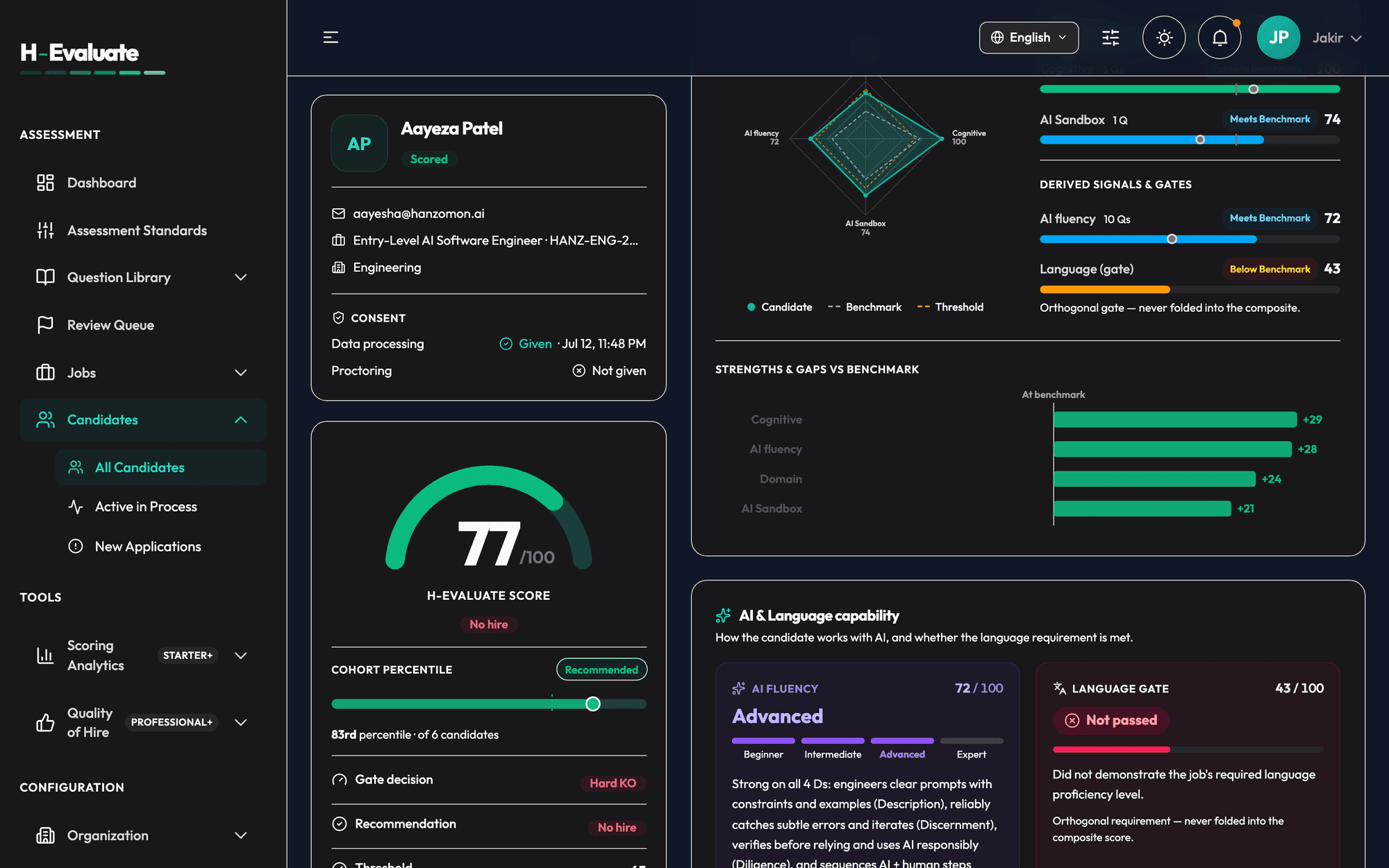
One position, plainly stated: if a role uses AI daily, an interview conducted entirely without a task is measuring a version of the job that no longer exists. The questions are still worth asking — they tell you how someone thinks — but on their own they reward the candidate who interviews well over the one who works well. Pair the two. We build assessments, so weigh that as you read this, but the argument holds whether you use ours or not: for a skill this easy to narrate and this hard to fake, watching beats listening. That is the throughline of treating fluency as a real hiring signal rather than a line on a job description, which we argue in AI fluency as a hiring signal. To see a role-tuned task get composed, book a demo.
The candidate recites how carefully they verify AI output, word-perfect. Then the task hands them a draft with a confident error in the second paragraph, and they ship it. Interviews sample the story; work samples sample the work — and only one of them is buying you a hire you can trust.
Written by
Aayesha Patel · Co-founder, Hanzomon Inc
Co-founder of Hanzomon. Writes about skills-based hiring, fair assessment and building a better candidate experience.