Hiring · August 2, 2026 · 12 min read
Behavioural interview questions: how to evaluate answers
Behavioural interview questions for interviewers: 25 questions by competency, what strong and weak answers sound like, and how to probe rehearsed stories.
← Part of The pillars of hiring: what assessments measure
On this page
This guide is for the interviewer and hiring manager, not the candidate. If you have ever finished a friendly hour, written "strong communicator, great culture fit," and then watched the hire struggle at the actual work, this is about closing that gap. Behavioural interview questions ask what a candidate has actually done, on the reasoning that past behaviour predicts future behaviour better than stated intentions. Done well, they are among the sharpest tools you have for judging ownership, collaboration and judgement under pressure; done the usual way, they reward whoever tells the smoothest story. The difference is not the questions. It is what you listen for, and how hard you probe once the rehearsed part runs out.
There is a newer problem too, worth naming bluntly. In 2026 a candidate can rehearse a flawless answer to every common behavioural question in an evening, with an assistant to structure the arc and smooth the language. A memorisable list of questions is now a leaked exam: if your interview is a set of predictable prompts scored on delivery, you are measuring who prepared, not who can do the job. This guide gives you the questions grouped by competency, what strong and weak answers sound like, a scoring approach, and the point at which you should stop asking and start testing. It assumes you have read the structured interviews guide; this is the question-level companion.
How do you score interview answers consistently?
Score every candidate on the same questions against a written, behaviourally-anchored scale you agreed before the first interview. That single discipline does most of the work; without it, a behavioural interview measures the interviewer's mood as much as the candidate's history.
This is well-established interview science, not anything proprietary. Pick a small set of questions, one to three per competency, and use them for everyone. For each, write in advance what a weak, an average and a strong answer looks like, with a short example behaviour at each level. A five-point scale with no anchors is barely better than a gut call, because a four means something different to every rater; anchored, a four means the same thing across the panel. Have everyone score independently before they discuss, so the loudest voice in the debrief does not set the consensus.
If you cannot describe what a strong answer to a question looks like before the interview, the question is too vague to score, and it will quietly become an unstructured question in practice. Write the anchor and the question together, or cut the question.
One more tool, used correctly. STAR, Situation, Task, Action, Result, is not a script to coach candidates through; it is your probing map, telling you where a thin answer is thin. A candidate who narrates a rich Situation and a triumphant Result but blurs the Action is telling you the team did the work, so ask what they personally did. The four parts are most useful as the places a rehearsed story tends to go smooth and hollow at once.
Ownership and follow-through
This competency is about whether a person owns outcomes or owns tasks. The tell is pronouns and specifics: owners say "I" and can name the cost of their decisions; task-doers say "we" and describe activity. Every question below asks for a concrete past event, glossed with its strong answer and red flag.
- Tell me about a commitment you made that became much harder than expected. What did you do when it slipped? — Strong: names the slip early, owns the recovery, says who they told. Red flag: discovers the slip only when someone else does.
- Describe a decision you made alone, under time pressure, that turned out to be wrong. — Strong: states the decision, how they found out, and what it cost. Red flag: reframes the failure as a success, or blames the information they had.
- Walk me through something you shipped end to end. Where did it nearly fall over? — Strong: owns the fragile part and how they de-risked it. Red flag: describes only the happy path and cannot name a risk.
- Tell me about a time you inherited a mess someone else made. What did you actually change? — Strong: fixes the system, not just the symptom, without trashing the predecessor. Red flag: spends the answer assigning blame.
- Give me an example of a promise you had to break to a colleague or customer. — Strong: names the trade-off, told them early, and repaired the relationship. Red flag: avoided the conversation and let the deadline pass silently.
- Tell me about a time you noticed a problem that was not your job to fix. — Strong: acted or escalated with a reason. Red flag: saw it, said nothing, and calls that staying in their lane.
Take the failed-decision question, because it separates seniority cleanly. A junior answer locates the failure outside themselves: the requirements were wrong, the data was bad, nobody told them. A senior answer starts from what they controlled: "I shipped without the extra validation to hit the launch, and I was wrong; a bad record got through and a customer caught it. Now I never trade away the last safety check under deadline pressure." Same mistake; the difference is who owns it, and whether the lesson changed a specific later behaviour rather than a tidy platitude.
AI-era note: ownership stories are now the most rehearsed of all, and an assistant produces a clean "I owned it, here is what I learned" arc effortlessly. Do not score the arc. Probe for the cost, the exact date, and the specific later behaviour that changed. The follow-up that survives preparation is a work sample where you watch the person own a live problem, not narrate a past one.
Collaboration and conflict
Most candidates know to sound collaborative, so the generic "tell me about a time you worked on a team" is close to worthless now; everyone has a rehearsed, harmonious answer ready. Ask about friction instead: real collaboration shows up in how someone handles disagreement, not in how warmly they describe teamwork. Each question below targets a specific stress point.
- Tell me about a time you disagreed with your manager on something that mattered. What did you do? — Strong: made the case, then committed to the decision or escalated cleanly. Red flag: either always deferred, or went around them quietly.
- Describe a conflict with a peer that you were partly responsible for. — Strong: names their own contribution to the friction. Red flag: casts themselves as the reasonable party in every telling.
- Give me an example of giving hard feedback to someone who did not want to hear it. — Strong: specific, kind, and followed up. Red flag: confuses bluntness with candour, or avoided it entirely.
- Tell me about a time you had to influence people who did not report to you. — Strong: built the case and understood the other side's incentives. Red flag: relied on authority they did not have, then gave up.
- Describe a situation where two stakeholders wanted incompatible things from you at once. — Strong: surfaced the trade-off explicitly and named who they consulted. Red flag: resolved it by simply deferring to whoever was more senior.
- Walk me through the last time you delivered bad news up the chain. — Strong: early, factual, with a proposed path forward. Red flag: waited, softened it into uselessness, or let someone else deliver it.
The disagreed-with-my-manager question is the flagship here, and it splits candidates three ways. The weakest cannot name a single disagreement, which usually means they never engage or are managing the interview. The middling answer disagreed, was overruled, and is still faintly bitter about being right. The strong answer, and the seniority tell, is disagree-and-commit: they made the argument with evidence, lost, and then executed the decision as their own, because relitigating it would cost the team more than being right was worth.
Watch the pronouns on the conflict-with-a-peer question. The instruction was "a conflict you were partly responsible for," and a surprising number of candidates cannot honour the "partly": they were entirely reasonable and the other person entirely the problem. That is not a story about collaboration but about self-perception, and it predicts how they will describe the next conflict, the one with your team.
AI-era note: conflict stories prepped with an assistant arrive pre-absolved, the candidate always the mature party who de-escalated. Probe for their own contribution to the friction and for what the other person would say about the same event. If both sides sound identical and flattering, you are hearing a script. A group exercise or a live disagreement in a work sample shows you the behaviour the story cannot.
Adaptability and learning
This competency matters more than it used to, because tools and priorities now shift under people mid-project. You are testing whether someone treats change as a threat to manage or a normal condition of the work, and whether they learn from being wrong or just move on. Beware the polished "I love learning" answer; ask for a specific thing recently learned.
- Tell me about the last significant thing you learned because the job forced you to. — Strong: names the skill, how they learned it, and where they used it. Red flag: speaks about learning in the abstract with no example.
- Describe a time the goalposts moved halfway through a project. How did you respond? — Strong: re-planned without drama and communicated the change. Red flag: kept building the original thing out of momentum.
- Give me an example of feedback that stung but changed how you work. — Strong: can quote the feedback and name the behaviour it changed. Red flag: only recalls praise, or dismisses the critique as unfair.
- Tell me about a time you were clearly the least experienced person in the room. — Strong: got up to speed deliberately and contributed anyway. Red flag: stayed silent and calls it humility.
- Describe adopting a new tool or method you were sceptical about. — Strong: tested it honestly and updated their view either way. Red flag: dismissed it on reputation without trying it.
- Walk me through a strong opinion you have since reversed. — Strong: says what evidence moved them. Red flag: has never reversed a professional opinion.
The strong-opinion-reversed question is the one I would keep if I could keep only one. It is hard to rehearse convincingly, because a genuine reversal requires the person to have held a real position, met specific evidence, and changed. A junior answer reverses a preference without much reasoning. A senior answer reverses a belief and can tell you exactly what moved them: a project that failed the way the old view said it would not, a mentor's argument they resisted and then could not refute. Specific disconfirming evidence is the signal; its absence usually means the reversal did not really happen.
AI-era note: adaptability is the competency most distorted by rehearsal, because "I embraced the change and grew" is exactly the shape an assistant produces. The texture that survives is specificity, what changed, when, and what they did differently the next week. The follow-up that beats preparation is a genuinely unfamiliar problem in a work sample where AI tools are available, so you watch how they orient when they cannot fall back on a rehearsed narrative.
Judgement under ambiguity
The senior differentiator is here. Junior people execute well-specified tasks; senior people make good calls when the task is under-specified, the information incomplete, and no one is coming to decide for them, which is most of real work above a certain level.
- Tell me about a decision you made with much less information than you wanted. — Strong: names what they assumed, what they checked first, and how they hedged. Red flag: waited for certainty that was never coming.
- Describe a time you shipped an 80% solution on purpose. — Strong: says what they cut, why, and how they flagged the gap. Red flag: cannot distinguish 80% from cutting corners.
- Give me an example of a risk you decided not to take. — Strong: reasons about downside and reversibility. Red flag: only tells stories where boldness paid off.
- Tell me about a problem where the obvious solution was wrong. — Strong: describes how they caught it before committing. Red flag: only saw it in hindsight, if at all.
- Walk me through prioritising when everything was labelled urgent. — Strong: has an actual method and can name what they let slip. Red flag: worked longer hours instead of choosing.
- Tell me about the hardest judgement call you have made where reasonable people would disagree. — Strong: steel-mans the other choice. Red flag: cannot articulate why anyone would decide differently.
The 80%-solution question is deceptively revealing, so probe it. The distinction weak candidates miss is the one that matters: a good 80% solution is a deliberate scope decision that solves the real problem now and names the deferred 20% openly; corner-cutting hides the missing 20% and hopes no one notices. Ask how they communicated the gap. The candidate who told the stakeholder exactly what was not yet handled is showing you judgement and honesty at once; the one who "just shipped it" is showing you a future incident.
The best probe on the hardest-judgement-call question is to ask them to argue the other side: "Make the case for the decision you didn't make." A senior person can steel-man the road not taken fluently, because they genuinely weighed it; that is why the call was hard. Someone who reconstructed the justification after the fact just restates why their choice was correct, which tells you it was never a hard call.
When should you stop asking and start testing?
When you have heard the story and now want to see the behaviour. Interviews sample claims; work samples sample the work. A behavioural interview, even a well-probed one, is still a candidate's account of their own past, mediated by memory, framing and, increasingly, preparation. There is a ceiling on how much you can verify by asking; past it, you reward better storytelling, not better work.
The sequence that works puts the evidence first. Run a job-relevant assessment before the interview loop, then let what it surfaces decide which behavioural probes are worth your scarce minutes. If a candidate handled ambiguity well in a work sample, spend the interview on collaboration and ownership instead of re-testing judgement from a blank page. Behavioural questions are strongest when they interrogate real evidence rather than a fresh guess. For the interpersonal scenarios a work sample cannot fully stage, situational judgement questions cover the gap. And a mis-hire in a senior role is one of the most expensive mistakes a team makes, which is the whole reason to verify behaviour rather than reward storytelling.
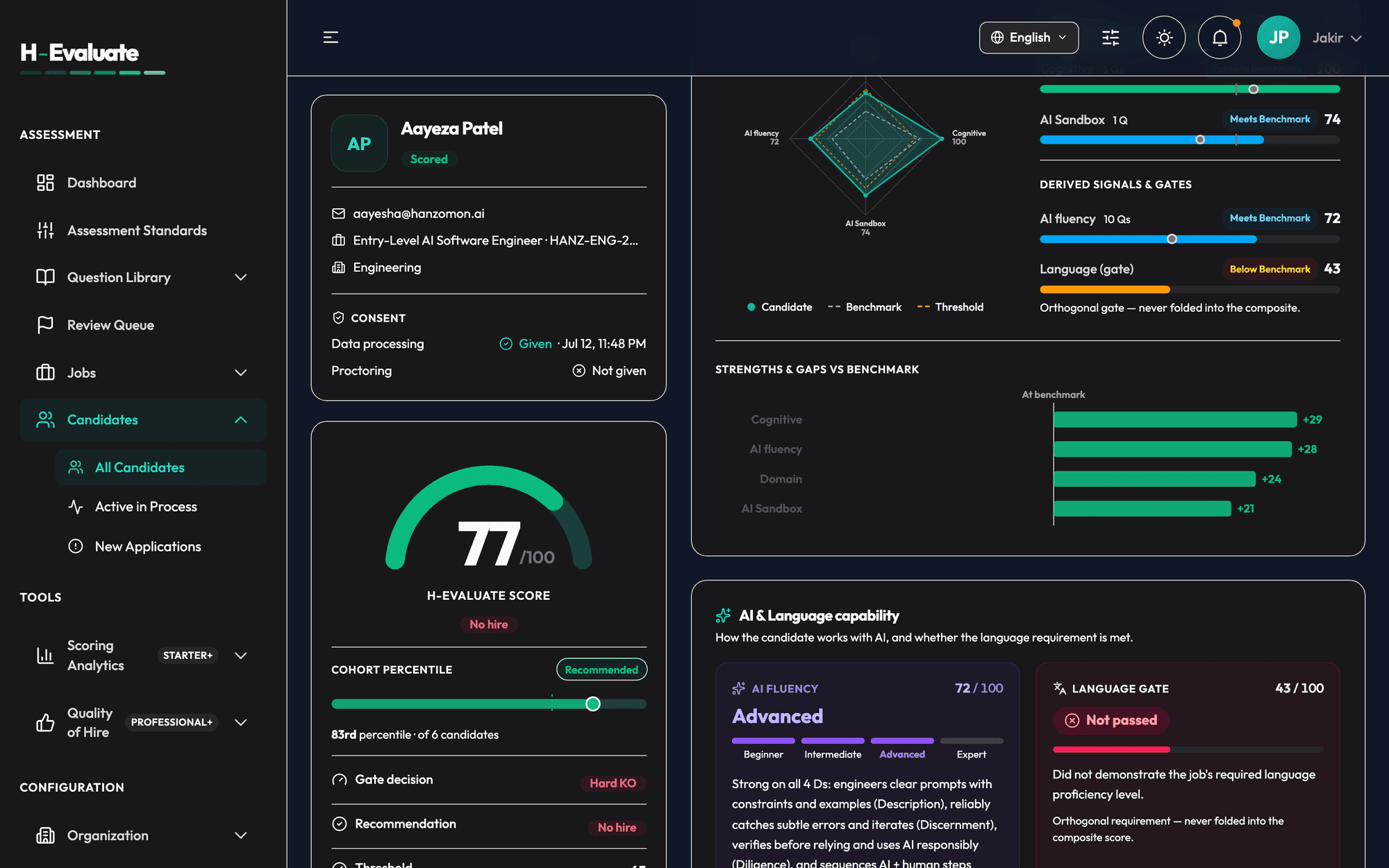
This is where an AI-native skills assessment platform earns its place, generating a job-relevant assessment per opening and scoring every candidate on the same standard, so the interview arrives with real evidence rather than a first impression. You can see how this works for the harder-to-stage scenarios in a situational judgement assessment or book a demo. The point is not to replace the behavioural interview but to free it from a job it cannot do, and let it do the one it does well: understanding how and why someone works the way they do.
What to cut from your loop
Some classic behavioural questions have aged into pure theatre, and I would drop them. "What is your greatest weakness" now returns a rehearsed strength-in-disguise from everyone; it tests preparation, not self-awareness. "Where do you see yourself in five years" measures fluency with a genre, not judgement, and "tell me about yourself" hands the confident candidate an open runway and tells you little a CV would not. Replace each with a question that demands a specific past event you can probe, and you recover the interview time these questions quietly waste.
The deeper shift is to stop treating the behavioural interview as a lie detector for prepared answers, because it is a bad one and getting worse. Assume preparation; assume an assistant helped. Then build your evaluation so that assumption does not matter: same questions for everyone, anchored scoring, relentless probing for the texture preparation cannot manufacture, and a work sample carrying the weight of "can they actually do it."
The behavioural interview never measured the past. It measured how well someone tells it. In 2026 everyone tells it well, so stop scoring the telling and start probing for the texture underneath, then let a work sample settle whether they can actually do the thing they described.
Written by
Aayesha Patel · Co-founder, Hanzomon Inc
Co-founder of Hanzomon. Writes about skills-based hiring, fair assessment and building a better candidate experience.