Hiring · July 29, 2026 · 10 min read
How to hire an AI product manager: what to test
How to hire an AI product manager: what the role owns, how it differs from classic PM, the evaluation literacy to test for, and work samples that reveal it.
← Part of The five pillars of hiring: what assessments measure
On this page
- What does an AI product manager actually do?
- Why does this role exist now?
- Do you actually need one?
- What separates a strong AI product manager from a rebranded one?
- How do you test those skills?
- 1. Write the evaluation criteria for a feature
- 2. Triage a hallucination incident
- 3. Decide a model-versus-rules trade-off
- What does the interview loop look like?
- Seniority and compensation, honestly
- The first 90 days: what good looks like
If one of your teams now ships a feature that talks back — a copilot, a summariser, an agent that takes actions — you are probably about to hire an AI product manager, and you should know why the title exists before you start. Classic product management assumes deterministic features: you write a spec, engineering builds it, and the thing behaves the same way for every user, every time. Put a model underneath and that assumption collapses. Output varies, it is sometimes confidently wrong, and 'does it meet the spec' stops being a yes-or-no question. The AI product manager owns exactly that gap: scoping what the model should and shouldn't attempt, defining what 'good' looks like for output nobody can fully predict, and owning what happens when it fails. This guide is for the hiring managers who have to tell that person apart from the many who simply added 'AI' to a product title. It is one of five in our series on the roles AI created, alongside the AI engineer, the prompt engineer, the AI agent engineer and the AI governance lead.
What does an AI product manager actually do?
An AI product manager runs the same discovery-to-launch loop as any PM, but the middle of it looks different because the feature they are shipping will not behave the same way twice. Their week is less 'write the spec' and more 'decide what counts as good enough, and design for the times it isn't.' Concretely, the day-to-day tends to look like this:
- Scope what the model should and shouldn't attempt — drawing the line between the cases where a generated answer is genuinely useful and the cases where it is too risky or too unreliable to ship at all.
- Define the evaluation criteria for the feature: what 'good output' means in concrete, checkable terms, and how the team will know whether a change made things better or quietly worse.
- Set and hold a quality bar for non-deterministic output — deciding how good is good enough to ship, given that no version will ever be perfect.
- Make build-versus-buy model calls: use a third-party model, fine-tune, or build something in-house, weighing cost, latency, control and how fast the frontier is moving.
- Own the guardrails and escalation experience — what the product does when the model is uncertain or wrong, and how a user gets to a human or a safe default instead of a confident mistake.
- Translate model limits into roadmap honesty — telling stakeholders what the model genuinely cannot do yet, rather than promising a demo that fell over the third time it ran.
Notice how little of that is 'prompt the model well.' The prompt is a means; the job is judgement about a probabilistic system. That distinction matters enormously when you start assessing candidates, because the market is full of people who can demo a clever prompt and far fewer who can tell you, with a straight face, when the feature should refuse to answer.
Why does this role exist now?
Because shipping on top of a model turned out to be a distinct craft, not a variation on the old one. A payments flow either charges the card or it doesn't; you can write acceptance criteria that pass or fail. A language model can give you two different answers to the same input, one of them subtly wrong, both of them fluent. That single property cascades into everything this role does. You can't write a fixed spec for behaviour you can't predict, so you write evaluation criteria instead. You can't promise a feature works, so you reason about how often it does and what failures cost. None of that appears on the checklist in how to hire a product manager — and that's the point. Now it is a job. We cover the broader shift in AI-native hiring; the AI product manager is one of its sharpest examples.
The defining shift is from specifying behaviour to defining quality. A classic PM asks 'does it do what the spec says?' An AI product manager asks 'how do we know the output is good, how often, and what happens when it isn't?' Everything you test for should ladder up to that question.
Do you actually need one?
Often, no — and a good candidate for the role will tell you so before you finish the pitch. Adding a single model call behind an existing feature does not require a dedicated hire; your current product manager, with one capable engineer, can own that perfectly well. Reaching for a specialist too early is a real failure mode: it usually ends with an expensive person managing a feature that didn't need them and getting bored.
You genuinely need one when the probabilistic component moves from garnish to main course — when the model's output is central to what the product is worth, and the cost of it being confidently wrong is high enough that someone must own that failure mode as their actual job. A support copilot that drafts refunds, an agent that files tickets, a summariser that lawyers rely on: those need an owner who thinks about error rates for a living. A 'summarise this' button bolted onto a settings page does not. If you're not sure which you have, that uncertainty is itself the answer — start with your existing PM and hire the specialist when the judgement calls start piling up.
What separates a strong AI product manager from a rebranded one?
Every one of these titles attracts rebranded CVs, and this one attracts them badly. The classic impostor here is the product manager who shipped one chatbot, added 'AI' to the title, and now presents as a specialist. Shipping a chatbot is not nothing — but it is not evidence of the skill that matters, and the interview has to be built to tell the two apart. Here is what the real thing looks like:
- Evaluation literacy — the single strongest signal. Can they define what 'good output' means for a feature, in terms concrete enough to measure? A rebranded candidate talks about the model being 'accurate'; the real specialist tells you what accurate means for this task, how they'd sample it, and how they'd catch a regression before users do.
- Judgement about when not to use a model — knowing which problems a model is the wrong tool for, and being willing to say a deterministic rule or a plain form would serve users better. The impostor reaches for the model reflexively; the strong candidate reaches for it selectively.
- Comfort reasoning about error rates with stakeholders — sitting across from a non-technical exec and explaining, without hand-waving, that the feature is right most of the time and here is the plan for the rest. This is where most rebranded candidates fold, because it is uncomfortable and specific.
- Guardrail and escalation design sense — treating 'what happens when the model is wrong' as core product work, not an edge case to file later.
- Roadmap honesty — describing what the model genuinely cannot do yet, rather than what a cherry-picked demo suggested it might.
You'll notice deep machine-learning maths isn't on that list. It's useful, and for some products it matters, but it is not the thing that separates strong from weak. Plenty of excellent AI product managers couldn't derive a loss function to save their lives. What they can do is scope a probabilistic problem, hold a quality bar under pressure, and reason honestly about failure — and that is a product skill, not a research one.
The most common mis-hire is the confident demo-driver — the candidate who dazzles with a slick prototype and can't tell you when the feature should refuse to answer. A demo shows the happy path. The job is the unhappy path. Assess the second one, or you'll hire for the first.
How do you test those skills?
You test them the way you'd test any real skill: with job-shaped work, not trivia. Interview questions about transformer architecture tell you whether someone crammed; they say nothing about whether this person can hold a quality bar. Hand candidates the actual work and watch how they do it — three exercises cover most of the signal, each mapping to one of the skills above. Run them with AI tools genuinely available, because that is how the job is done. This is the same show-me-don't-tell-me logic behind work-sample tests.
1. Write the evaluation criteria for a feature
Give them a plausible AI feature — say, a copilot that drafts replies to customer emails — and ask them to write the evaluation criteria: what does 'good output' mean here, how would you measure it, and how would you catch a regression when the model changes underneath you? This is the highest-signal exercise in the loop. A strong candidate produces concrete, checkable criteria and names the failure modes that matter for this specific task. A rebranded one produces vague adjectives and hopes you'll nod along.
2. Triage a hallucination incident
Hand them a scenario: your shipped feature just told a customer something confidently false, and it's on social media. What do you do in the next hour, the next day, the next sprint? Watch whether they can separate the immediate mitigation from the systemic fix, whether they reason about how often this happens rather than treating it as a one-off, and whether they think about the affected user, not just the metric. This exercise reveals guardrail thinking and error-rate reasoning at the same time.
3. Decide a model-versus-rules trade-off
Present a problem that could be solved with a model or with plain deterministic rules — routing a support ticket, say — and ask them to make and defend the call. The point isn't the answer; it's the reasoning. A strong candidate weighs the error cost, the maintenance burden, the explainability, and the failure mode of each, and sometimes lands on 'don't use a model here at all.' That willingness is the tell. It connects directly to AI fluency as a hiring signal — knowing when not to reach for the tool is half of fluency.
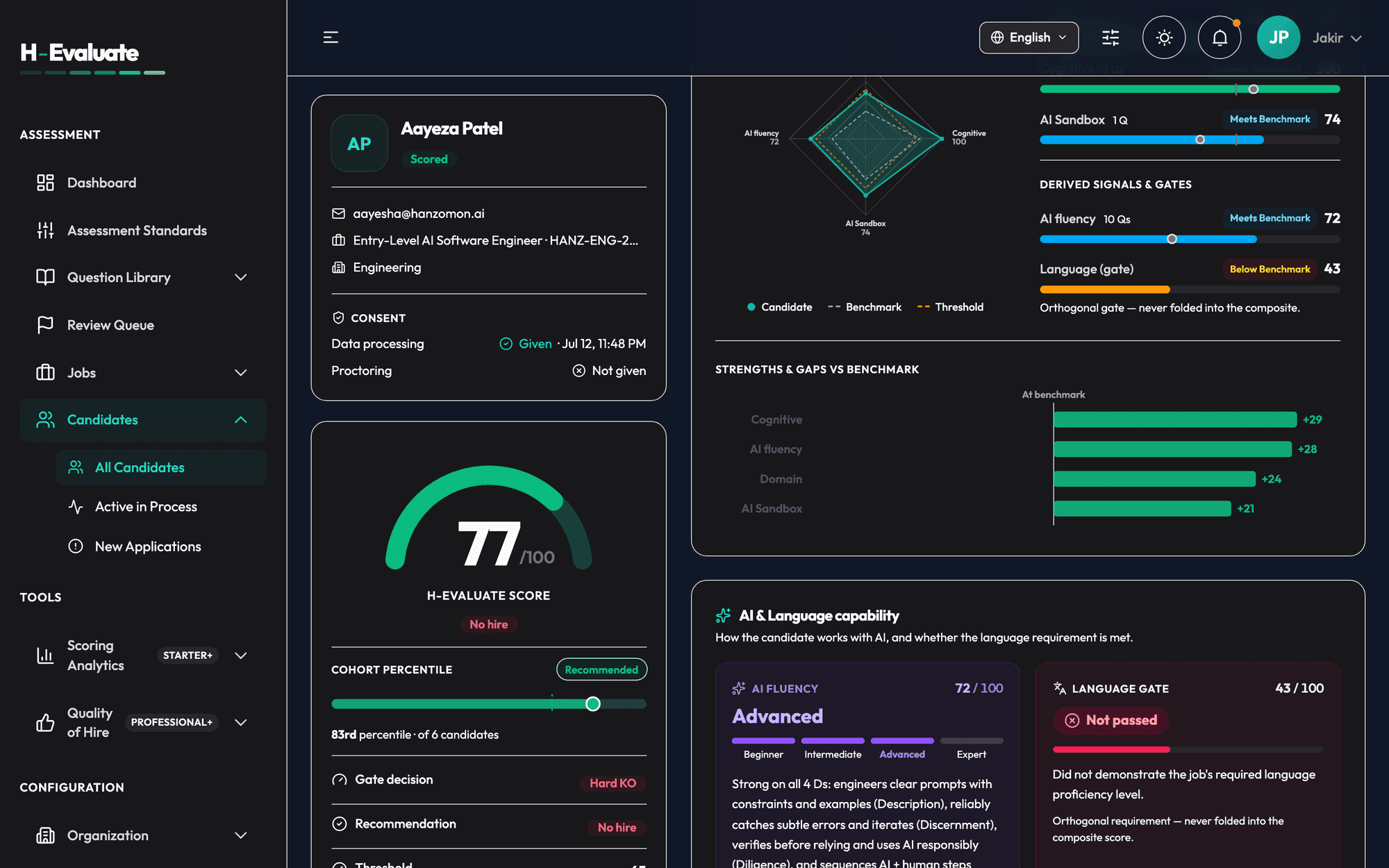
Running these observed, with AI tools in the room, is where our own view lands. The AI Sandbox is built to put a candidate in a realistic environment with those tools available and let you watch the process, not just read the artefact — which is, admittedly, exactly what a vendor would say. What you're grading is judgement under non-determinism, and you can only see judgement by watching someone exercise it. For the framework behind reading those signals cleanly, how to assess AI fluency and the 4D framework do the heavy lifting; delegation and discernment carry the most weight for this role.
What does the interview loop look like?
Keep it structured and keep it short. A shared scorecard, the same exercises for every candidate at a given level, and a debrief that argues over evidence rather than trading first impressions — that discipline is what makes the decision fair and defensible, and it matters more here than usual because 'she seemed to really get AI' is exactly the kind of vibe that hides a rebranded CV. Read structured interviews for the mechanics. A loop that works:
- Recruiter screen — confirm scope and seniority, and probe once: ask them to describe an AI feature they owned and what 'good' meant for it. The answer sorts the field fast.
- Evaluation-criteria work sample — the exercise above, done as observed work with AI available, scored against a shared rubric.
- Cross-functional interview — an ML or applied engineer probes the build-versus-buy and model-versus-rules reasoning; a design partner probes the guardrail and escalation experience.
- Stakeholder-communication interview — someone non-technical, ideally, tests whether the candidate can explain error rates and roadmap honesty without hiding behind jargon.
- Debrief against the scorecard — every interviewer brings evidence tied to the dimensions above, and you decide on the aggregate, not the loudest voice in the room.
Seniority and compensation, honestly
We won't invent numbers — market ranges for this role shift too fast to quote responsibly. Qualitatively: because the role blends classic product judgement with a scarce newer skill, it tends to sit at or above the equivalent classic PM band, with a scarcity premium that is real but cooling as the skill spreads. Seniority tracks the stakes of the probabilistic component more than years served. Benchmark against your own market, and weight demonstrated evaluation literacy over title inflation — in this role the titles are especially noisy.
The first 90 days: what good looks like
A strong AI product manager spends their first month doing something unglamorous: getting honest about how the existing feature really behaves. That means building or fixing the evaluation setup so the team can tell whether a change helped, and sitting with real failure cases rather than the demo. By 90 days, good looks like a team with a shared, concrete definition of 'good output' for its main feature, a guardrail-and-escalation story for when the model is wrong, and a roadmap stakeholders trust because it was honest about limits from the start. If instead you've got a flurry of new demos and no clearer sense of whether the thing works, you hired the demo-driver — and you'll feel it in the second quarter.
This role isn't classic product management with a coat of paint, and it isn't machine-learning research either. It's a specific craft: owning a feature that behaves probabilistically, defining what good means when the output won't hold still, and being honest — with users, stakeholders and yourself — about where the model falls short. Hire for that, test for it with job-shaped work, and be willing to conclude you don't need the role yet.
Written by
Aayesha Patel · Co-founder, Hanzomon Inc
Co-founder of Hanzomon. Writes about skills-based hiring, fair assessment and building a better candidate experience.