Hiring · July 30, 2026 · 10 min read
TOEIC scores in hiring: what the number proves
TOEIC scores gate English roles across Japan and Korea, yet the standard test has no speaking or writing and expires in two years. What the number proves.
← Part of The five pillars of hiring: what assessments measure
On this page
- What does a TOEIC score actually certify?
- Where do TOEIC scores genuinely help in hiring?
- What are the structural gaps in using TOEIC to hire?
- It measures no production — the skills most jobs run on
- It is built to expire — but old scores live on CVs
- What does 'work English' actually mean, role by role?
- How do you assess the working English a TOEIC score misses?
- How do you set a fair TOEIC bar without over-filtering?
If you lead HR or set hiring standards for English-facing roles in Japan or Korea — or you run a global team recruiting into either market — the TOEIC line on a CV is probably carrying more weight in your decisions than you have looked at closely. That weight is not misplaced by default: a strong TOEIC score is a real, hard-won signal, and candidates who earn one have demonstrated something genuine. But using TOEIC scores in hiring well means being precise about what the number proves and what it structurally cannot. The stakes are rising as English requirements tighten across both markets and competition for bilingual talent intensifies, which makes an over-read or under-read score an expensive habit.
This is not an argument against the TOEIC. It is an argument for reading it accurately. If you have followed our companion piece on JLPT N1 and N2 in hiring, the shape of the problem will feel familiar — and that is the point. Corporate English screening in Japan and Korea rests overwhelmingly on a test with no speaking and no writing section, the mirror image of the receptive-only critique we made of the JLPT. Once you see that clearly, the right use of the score becomes obvious: treat it as a signal to filter people in, then assess the actual working English the role runs on.
What does a TOEIC score actually certify?
The standard TOEIC — the one nearly everyone means when they say 'TOEIC' — is the Listening and Reading test. According to ETS, which produces it, that test runs about two hours, contains 200 questions, and reports a scaled score from 10 to 990. It measures comprehension: whether a candidate can follow spoken English and read written English at a defined level. That is worth knowing, and the scale is fine-grained enough to rank candidates rather than merely pass or fail them.
Two facts about the test's design matter enormously for hiring, and both are easy to overlook. First, the standard test has no speaking section and no writing section. It measures whether you can understand English, not whether you can produce it. ETS does offer separate TOEIC Speaking and Writing tests, each scored from 0 to 200 — but they are distinct assessments, sat separately, and required by employers far less often than the Listening and Reading test. Most organisations that 'require a TOEIC score' are requiring the receptive-only one. Second, ETS states that an official score is valid for two years. The number on a CV is meant to have a shelf life.
The standard TOEIC is a comprehension test. It measures listening and reading only, reports a scaled score from 10 to 990, and — per ETS — is officially valid for two years. Speaking and Writing are separate tests, each 0 to 200, and rarely required. Everything about how you use a TOEIC score in hiring should follow from those facts.
None of this diminishes the achievement. Reaching a high TOEIC score takes sustained study and real comprehension ability, and it signals serious commitment to the language. The mistake is not respecting the score too much in the abstract; it is quietly treating it as proof of a broader working fluency the standard test was never built to measure. The TOEIC is precise about what it tests. Screening goes wrong when we are vaguer about it than the test itself is.
Where do TOEIC scores genuinely help in hiring?
In plenty of places. A TOEIC score is a fast, standardised, low-cost way to filter a large applicant pool down to people who clear a comprehension baseline — and standardisation is a genuine virtue, because it applies the same yardstick to every candidate rather than leaving English ability to an interviewer's impression. For roles where reading English documentation or understanding spoken briefings is the dominant language demand, the score maps closely to the work. It is also portable and independently administered, which makes it more trustworthy than a self-reported 'business-level English' that nobody ever verified.
So the sensible instinct is to keep the score, not discard it. It does one job well, cheaply and consistently: it tells you a candidate comprehends English at roughly a known level, which is worth having at the top of a funnel. The trouble starts only when comprehension is not the whole of the job — which, for most roles that list English as a requirement, it is not. The English a role advertises for is usually production, not the ability to understand.
What are the structural gaps in using TOEIC to hire?
There are two, and neither is a flaw in the test — the TOEIC does what it says. They are gaps between what the score measures and what most jobs actually run on. The first is that the standard test measures no production. The second is that the score is designed to age, yet the versions living on CVs frequently have not. Both are structural, so no amount of 'we prefer higher scores' resolves them.
It measures no production — the skills most jobs run on
Most English-language work is production, not comprehension. Writing a clear, correctly pitched email to a client. Holding a call and making a point that lands. Writing a specification another team can build from. The standard TOEIC tests none of this, because it has no speaking and no writing section. A candidate can understand every word of a customer's complaint and still be unable to write a reply that customer would receive well — and reception is exactly where tone and register quietly decide whether the message helps or harms. Comprehension and production are different muscles. The score exercises one and is silent on the other. This is the same critique we made of the JLPT, and it applies with equal force to English screening: gatekeeping a language role on a test that never asks the candidate to use the language productively.
It is built to expire — but old scores live on CVs
ETS gives an official score a two-year validity window, a sensible acknowledgement that language ability changes. Yet in practice, scores far older than that circulate freely on CVs — a number earned five or ten years ago, presented as current, accepted without a second look. That is a real problem, because language that goes unused fades. Research on language attrition, published in the journal Language Learning, finds that productive skills — speaking and writing — tend to erode before receptive ones when a language sits idle, and that higher attainment offers more protection against that decline. So an old TOEIC score is doubly weak evidence of production: it never measured production in the first place, and the receptive ability it did measure may itself have slipped since the exam day. When current working English matters, an out-of-date score overstates its own relevance.
The corporate thresholds you will hear quoted — figures around 600, 730 or 800 in Japan, and high-800s or 900-plus in Korea — are commonly cited conventions, not official ETS standards or fixed company policy. Different employers set very different bars for the same job title. Treat any specific number as a market convention to interrogate, not a settled requirement to inherit.
What does 'work English' actually mean, role by role?
Work English is the specific bundle of reading, listening, writing and speaking a particular role runs on, and the mix differs sharply by job — which is why a single TOEIC number is a poor proxy across roles. The useful question is not 'what score?' but 'what does this person have to do in English, all day, and can they do it?' A support agent lives on production under time pressure. They read a customer's message, understand the problem, then write a reply that is correct, clear and pitched at the right level of courtesy — often dozens of times a day. Comprehension gets them to the starting line; the job is the written reply and the tone inside it. The screening should start from the English the role produces, not the one it merely understands.
An engineer's mix is different. They may read English specs, pull requests and documentation all day — heavy comprehension — but produce mostly in code and short written updates, with speaking concentrated in stand-ups and design reviews. The reading bar can be high while the polished-writing bar is moderate. A sales rep inverts it again: their value can rest almost entirely on spoken persuasion and written follow-ups that build trust, where phrasing moves the deal. A blanket '800 TOEIC required' treats these three as the same problem. They are not. The score measures the one skill all three happen to share, and stays silent on the ones that actually separate a strong hire from a weak one in each case.
How do you assess the working English a TOEIC score misses?
Put the candidate in front of the work. The most predictive way to test production is a job-shaped task: ask a support candidate to write the reply to a real-looking customer complaint, in the register the role demands. Ask an engineer to summarise a short English spec, or explain a technical decision in writing. Run a short meeting simulation for a role that lives on spoken discussion. Each of these observes the actual skill the score cannot reach — and does it under conditions close enough to the job that the result predicts performance rather than approximating it.
This is the logic of work-sample tests applied to language: the closer an assessment sits to the real task, the better it predicts. A comprehension score is a proxy; a written client reply, observed and scored against a consistent rubric, is evidence. Use the score to filter in — it is cheap and standardised — then spend your assessment effort on the production skills that decide whether someone can do the job, not just understand it. That principle sits at the heart of skills-based hiring: decide what the role actually requires, measure that directly, and keep proxies in their place.
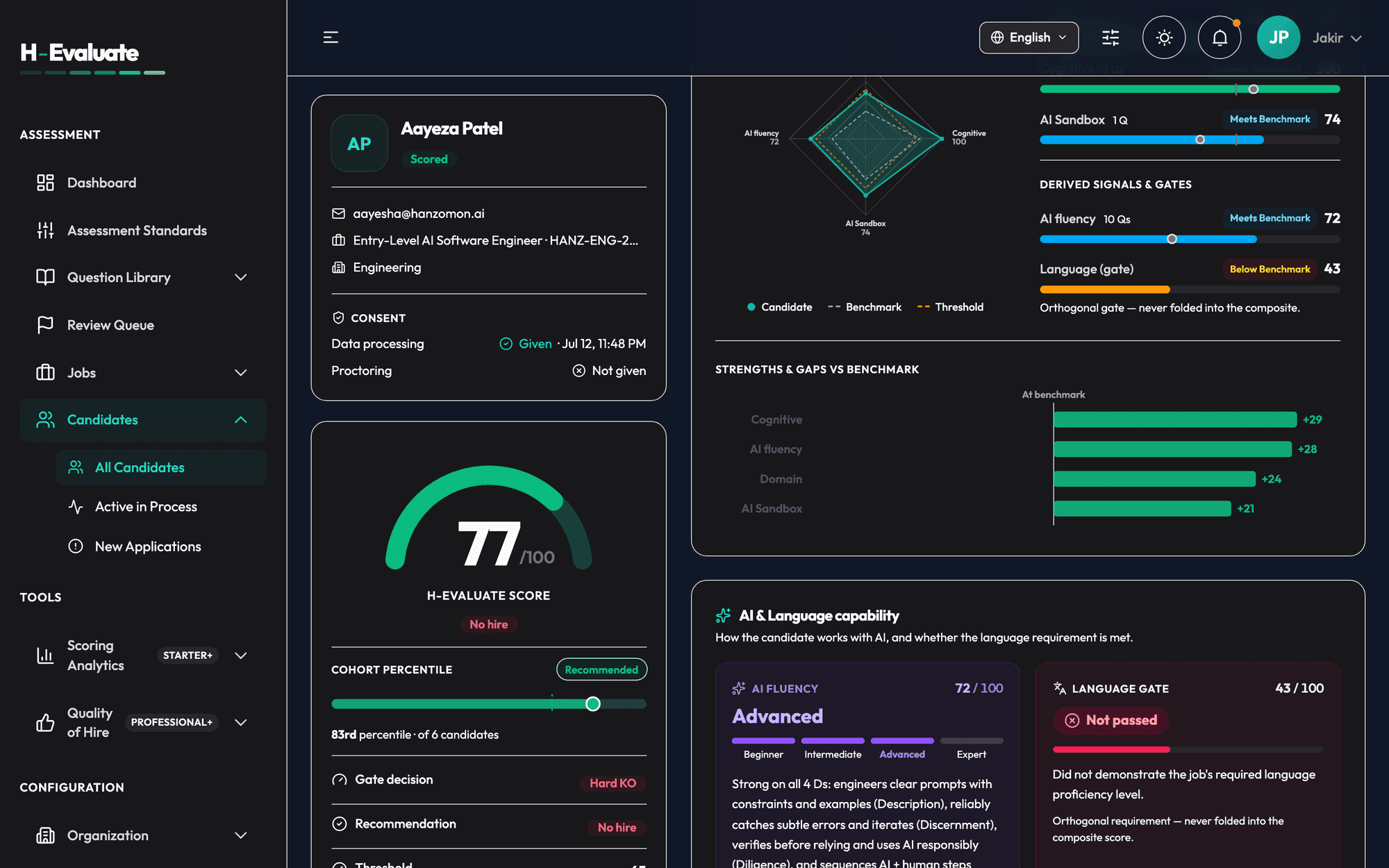
This is where a structured language gate earns its place. Rather than reading English ability off a CV line, you can set a hard language requirement at capability level — reading, listening and, crucially, writing — as a prerequisite a candidate clears before the role-specific questions begin. Our note on language proficiency in hiring makes the wider case: where the role depends on it, language is a job skill to be measured directly, not a claim to be trusted. An AI-native skills assessment platform can assess it natively, including modalities — a spoken response, a written reply — that a translated multiple-choice item cannot reach, which is why the sample assessment is built to separate genuine production ability from written recognition.
Use the TOEIC score as a filter-in signal, then assess production directly. Ask the support candidate to write the customer reply; ask the engineer to summarise the spec. A single job-shaped task tells you more about working English than a two-year-old score and an interview combined — because it observes the thing the role actually runs on.
For roles where speaking or writing is the whole game, the separate TOEIC Speaking and Writing tests are a fairer read than the Listening and Reading test alone, because they at least sample production. But they are sat far less often, add cost and scheduling, and still sit at one remove from your specific role — a generic writing prompt is not the client email your job will actually require. Even the most production-oriented certificate is a step towards the work, not a substitute for watching a candidate do it.
How do you set a fair TOEIC bar without over-filtering?
By matching the score requirement to what the role genuinely reads and listens to — and no higher. Demanding a 900 where a moderate score plus strong speaking would serve the work is not rigour; it is over-filtering. It shrinks an already competitive pool of English-capable talent in Japan and Korea, and it biases against capable people who never sat the test, or whose score understates their current ability, or who let a valid score lapse. The bar should track the job, applied identically to everyone who reaches it — not inherited from a market convention nobody in the room can justify for this particular role.
The fairness problem cuts both ways. Set the bar too high and you screen out strong candidates for a level the work never needed. Read the score too generously — accepting a decade-old number as current — and you advance people whose production skills nobody checked. A score is a proxy. Used as a filter-in signal paired with a real production assessment, it is a good one. Used as the whole decision, it quietly does unfair work — sometimes too strict, sometimes too lenient, always on the strength of a single exam day that may sit well outside its two-year window.
Don't let a TOEIC number become a blunt gate that stands in for the whole judgement. Requiring a top score everywhere over-filters a competitive talent pool and penalises capable people whose score understates their real English. Set the bar to the role's genuine demands, check the score is within its validity window, then assess production separately — good candidates have options.
Getting this right also protects the candidate experience, which matters more when the talent pool is competitive. A candidate asked to demonstrate the actual work — write a real reply, summarise a real document — generally finds it fairer than being filtered on a score alone, because it lets them show what they can do rather than only what they once passed. That is the spirit of using TOEIC well, and it sits alongside the wider permanent-residency and workforce changes reshaping how companies hire and retain foreign talent in Japan: respect the signal, read it precisely, and let the work settle the questions the score was never built to answer.
A TOEIC score proves a candidate comprehended English on one exam day — sometimes years past its two-year validity — and says nothing about whether they can write the client email your job runs on today. Respect the signal, then test the work.
If you want to see how job-shaped language assessment works in practice — a written reply or a spoken response scored against a consistent rubric rather than inferred from a certificate — you can try a sample assessment or book a demo before you change anything about how you screen for English.
Written by
Aayesha Patel · Co-founder, Hanzomon Inc
Co-founder of Hanzomon. Writes about skills-based hiring, fair assessment and building a better candidate experience.