Hiring · July 30, 2026 · 10 min read
CEFR levels in hiring: what "B2 required" really means
CEFR levels in hiring describe can-do ability, not workplace readiness. What A1-C2 measure, why "B2 required" misfires, and how to write a defensible bar.
← Part of The five pillars of hiring: what assessments measure
On this page
- What do CEFR levels actually describe?
- What does the Council of Europe say the CEFR is not?
- Why does copy-pasting "B2 required" misfire?
- How do the language certificates map onto CEFR levels?
- How do you write a defensible language requirement?
- Map role tasks to communicative activities
- Set a level per skill, not one blanket band
- How do you verify the level with a job-shaped assessment?
If you have ever written 'B2 English required' — or B1, or C1 — into a job ad, this post is for you, and it is meant kindly. CEFR levels in hiring have become a near-universal shorthand, and for good reason: they give a tight team of hiring managers a common word for 'good enough' language ability across borders and languages. But the shorthand hides a decision. Most 'B2 required' lines are pasted in without anyone asking which parts of the job the candidate actually has to do in the language, and a level pasted in blind can over-filter a scarce pool or wave through someone who cannot write the email the role runs on. This is the hub of a series on language certificates in hiring; the aim here is to be precise about what the Common European Framework of Reference for Languages describes, what its own authors say it does not, and how to turn a vague level into a requirement you can defend.
None of this is an argument against the CEFR. It is one of the most useful pieces of language infrastructure of the last thirty years. It is an argument for using it as its designers intended — as a shared reference you interpret for your context — rather than as a hiring gate it was never built to be. Once you see what a level genuinely tells you and what it structurally cannot, the constructive move becomes obvious: map the role's tasks to the language activities they need, set a level per skill, then verify with an assessment shaped like the job.
What do CEFR levels actually describe?
The CEFR is a framework published by the Council of Europe that sorts language ability into six levels: A1 and A2 (basic user), B1 and B2 (independent user), C1 and C2 (proficient user). Its foundation is a set of 'can-do' statements — descriptions of what a learner can do with the language at each level, written in positive, functional terms. B1, for instance, describes someone who can deal with most situations likely to arise while travelling, and produce simple connected text on familiar topics. The whole framework is descriptive: it tells you what a person can do, not which exam they passed.
Two features of the design matter enormously for hiring, and both are easy to overlook. First, the levels are deliberately broad. Each band spans a wide range of real ability, because the framework was built to compare and describe learning across many languages and contexts, not to slice ability finely. Second, and more importantly, the can-do statements are organised by communicative activity — reception, production, interaction, mediation, across listening, reading, speaking and writing — precisely because the Council of Europe expected a real profile to be uneven. A person can be B2 for reading and A2 for speaking. The framework's own structure assumes a spiky profile is normal. A single global level flattens exactly the detail the framework was designed to preserve.
The CEFR is a descriptive reference of can-do ability across six broad levels and four skills. It describes what a person can do with a language; it does not certify who they are for a job. Everything about using it well in hiring follows from that: respect it as a shared ruler, and never mistake the ruler for a measurement of the role in front of you.
What does the Council of Europe say the CEFR is not?
This is the part most job ads skip. The Council of Europe is unusually explicit about the framework's limits — its guidance repeatedly stresses that the CEFR is a reference tool requiring interpretation for each context, not a prescriptive standard to be applied mechanically. It was designed for learners, teachers, examiners and curriculum designers. It was not designed to certify workplace performance, and its authors caution against treating the levels as fixed thresholds that pass or fail people. The framework offers a common language for talking about ability; it deliberately leaves the interpretation to whoever uses it.
That matters because a hiring requirement is exactly the kind of high-stakes, prescriptive use the framework's authors warned about. When 'B2 required' becomes a hard gate, the level stops being a reference point you interpret and becomes a rule you apply — which is the one thing the Council of Europe says it is not for. There is even a running commentary in language-teaching circles about 'CEFR inflation': the tendency for institutions and job ads to quietly demand a level higher than the task needs, so that C1 becomes the new B2 and B2 the new B1. Present that as an observation rather than a finding — it is a pattern people notice, not a measured statistic — but it is real, and it starts precisely when a level is chosen without reference to the work.
Why does copy-pasting "B2 required" misfire?
Because a level answers the wrong question. 'B2 required' tells a candidate the band you want; it tells neither of you what the job actually demands. And since CEFR bands are broad, two people who both certify at B2 can perform very differently on the tasks that matter to you. One writes clean, correctly registered customer emails and goes quiet in a meeting. The other is confident and quick in conversation but produces written work that needs heavy editing. Both are, honestly, B2. The label cannot separate them, because the label was never meant to.
There is a second misfire, quieter but costly: the blanket level over-filters. A role that genuinely needs strong reading and moderate speaking does not need C1 across the board — but 'C1 required' screens out capable people whose speaking is exactly good enough and whose reading is excellent, along with everyone competent who never sat a certifying exam. In a tight, cross-border talent pool, that is an expensive habit dressed up as rigour. The discipline that resolves it is a skills-based one: decide what the role truly requires, measure that directly, and keep proxies in their place. A CEFR level is a proxy. Used as the whole decision, it quietly does unfair work in both directions — sometimes too strict, sometimes too lenient.
Don't let a single CEFR level stand in for the whole judgement. 'B2 required' pasted across all four skills over-filters a scarce pool and cannot separate two candidates who perform very differently on real tasks. Name the activities the role actually needs, set a level per skill, and verify the ones that matter — rather than gating on a band the framework's own authors say is not built to certify a job.
How do the language certificates map onto CEFR levels?
This is where the framework meets the exams, and where the series siblings come in — because 'B2' almost always arrives on a CV via a certificate, and each certificate maps to CEFR differently and carries its own blind spots. Reading the level well means reading the exam behind it.
For English, the standard TOEIC score in hiring reports a Listening and Reading number that gets translated into a CEFR band — but the standard test measures no speaking or writing at all, so a 'B2-equivalent' TOEIC says nothing about production. The same shape recurs across languages. Korea's TOPIK levels in hiring run one to six against CEFR-like bands, with speaking only now being piloted as a separate test. Japanese sits alongside them: the JLPT N1 or N2 question in hiring is the same story — high levels that certify comprehension and are silent on whether someone can write or speak the language at work.
The Romance-language exams test all four skills, so the critique shifts. For Spanish, the DELE and SIELE distinction in hiring turns on shelf life — DELE is valid for life, the purest snapshot that never ages, while SIELE reports a multilevel score valid for a few years. For French, the DELF and DALF question in hiring covers A1 through C2 across all four skills, also valid for life, with the same never-ages caveat. Each of these deserves its own read; the point for the hub is that 'CEFR B2' is not one thing. It is a band that different exams reach by different routes, some of which never test the skill your role most needs.
How do you write a defensible language requirement?
Start from the work, not the level. The constructive core of this whole series is a three-step move, and it is the opposite of pasting in a band. First, list what the role actually does in the language — the concrete communicative activities. Second, decide which of the four skills each activity draws on, and set a level for each skill separately. Third, verify the ones that matter with an assessment shaped like the job. The level becomes a floor for filtering, not the decision.
Map role tasks to communicative activities
Write down what the person will actually do, in the language, on a normal week. A support role reads customer messages and writes replies in the right register — reception plus written production under time pressure. An engineer reads specs and threads all day but produces mostly code and short updates, with speaking concentrated in stand-ups. A field sales rep lives on spoken interaction and trust-building follow-ups. These are different jobs in language terms, and the CEFR's own activity categories — reception, production, interaction — give you the vocabulary to describe them precisely instead of collapsing them into one band.
Set a level per skill, not one blanket band
Once you have the activities, the levels almost write themselves — and they will be uneven, which is correct. The support role might need C1 writing and B1 speaking. The engineer might need C1 reading and B2 writing but only B1 speaking. The sales rep inverts it: high speaking and interaction, moderate reading. A per-skill profile is more honest than 'B2 required', widens the pool fairly to people strong where it counts, and gives you a defensible answer if anyone ever asks why the bar is set where it is. This is the deeper argument in our note on language proficiency in hiring: where a role depends on language, treat it as a job skill to measure directly, not a single label to trust.
Replace 'B2 required' with a per-skill profile. Write what the role does in the language, map each task to a skill, then set a level for each skill that matters — 'C1 writing, B1 speaking' rather than one blanket band. It reads more precisely to candidates, filters more fairly, and gives you an assessment target instead of a slogan.
How do you verify the level with a job-shaped assessment?
Put the candidate in front of the work. A per-skill profile tells you what to check; a job-shaped task lets you check it. Ask a support candidate to write the reply to a real-looking customer message in the register the role demands. Ask an engineer to summarise a short spec in writing, or explain a technical decision. Run a brief meeting simulation where spoken interaction is the whole game. Each task observes the actual skill a certificate compresses into a band — and does it under conditions close enough to the job that the result predicts performance rather than approximating it. This is the logic of a work-sample test applied to language: the closer the assessment sits to the real task, the better it predicts.
There is a further reason to verify rather than trust the label: proficiency fades without use. Research on language attrition finds that productive skills — speaking and writing — tend to slip before receptive ones when a language goes unused, and that higher attainment offers some protection against that slide. So a level certified years ago, especially for the very production skills most roles run on, may quietly overstate where a candidate sits today. The framework has no expiry; people do drift. A short, current, job-shaped task cuts through all of it, because it observes present ability on the exact activity the role needs.
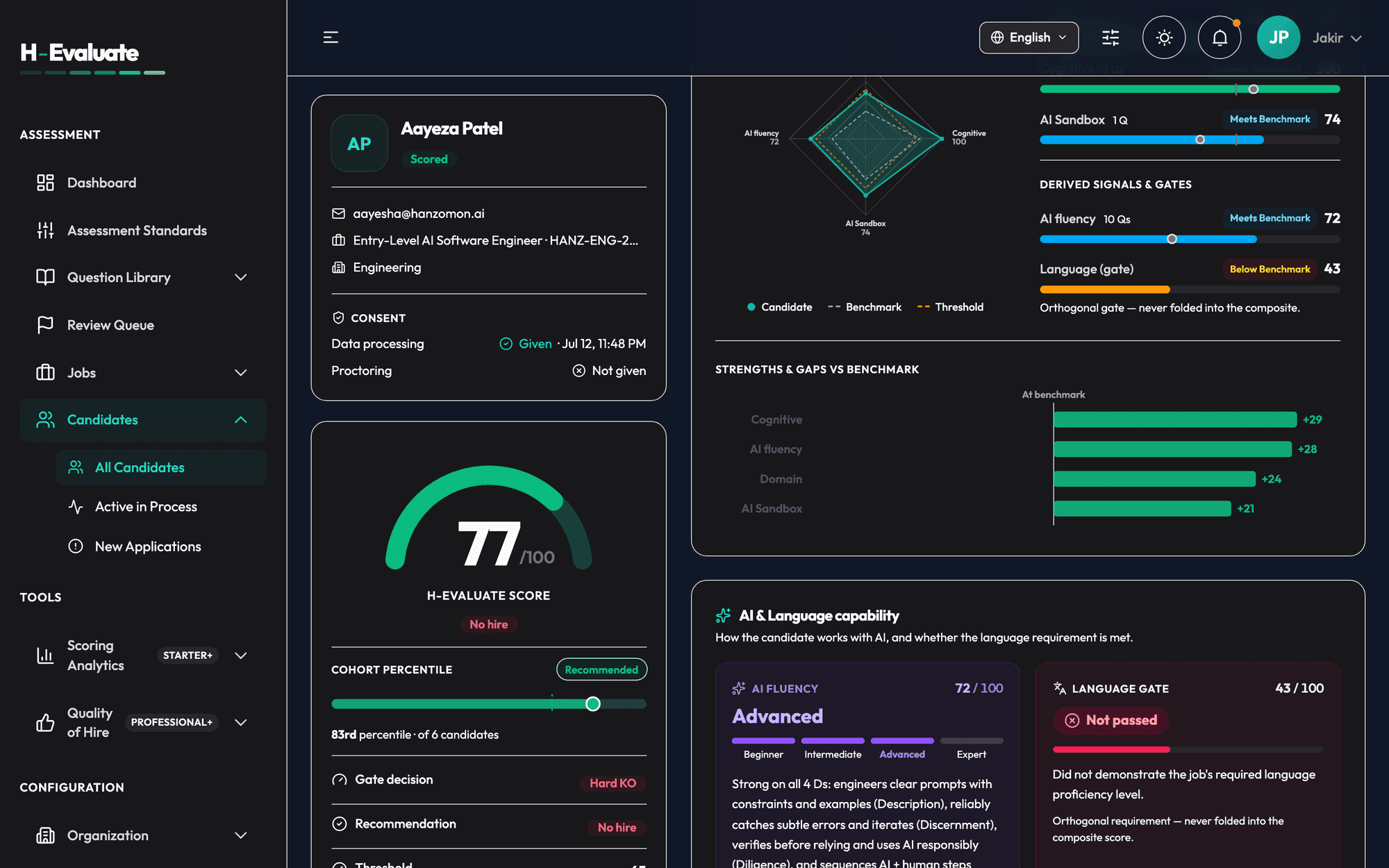
This is also where a structured language gate earns its place: rather than reading ability off a CEFR line, you set a hard language requirement at capability level — per skill — that a candidate clears before the role-specific questions begin, and you assess it natively, including listening and speaking that a translated multiple-choice item cannot reach. Our sample assessment shows the principle in practice: a task built to separate genuine ability from paper recognition, so the level on the CV becomes a filter you verify rather than a verdict you trust.
A CEFR level tells you the band a candidate reached on one exam, in one context, at one time. It cannot tell you whether they can write the email your role runs on today. Respect the framework for what it is — then let the work answer the questions it was never built to.
Used this way, the CEFR does exactly the job the Council of Europe designed it for: a shared reference that you interpret for your context. Map the tasks, set the levels per skill, verify what matters — and 'B2 required' turns from a slogan pasted into an ad into a language requirement you can stand behind. If you want to see how job-shaped language assessment works before you rewrite a single job description, you can try a sample assessment and read the rest of this series on how each certificate maps onto — and where each one falls short of — the levels it reports.
Written by
Aayesha Patel · Co-founder, Hanzomon Inc
Co-founder of Hanzomon. Writes about skills-based hiring, fair assessment and building a better candidate experience.