Hiring · July 30, 2026 · 10 min read
Do cognitive ability tests reduce bias in hiring?
Do cognitive ability tests reduce bias in hiring? Yes, against gut-feel judgement, but only when calibrated, weighted, and monitored for adverse impact.
← Part of The five pillars of hiring: what assessments measure
On this page
Ask whether cognitive ability tests reduce bias in hiring and you will get two confident, opposite answers. One camp says a standardised reasoning test is the fairest thing you can do, because everyone sits the same items. The other points to decades of research on group score differences and calls the whole category a legal landmine. Both are describing something real, and a hiring manager deciding whether to use the cognitive pillar deserves the honest version rather than either slogan. This post is that version — written for talent leaders who want the fairness question answered squarely, not waved away.
The stakes are high in both directions. Lean too hard on cognition and you narrow your funnel to good test-takers and invite adverse impact that a bias audit will flag. Drop it entirely and you fall back on the thing it was meant to replace: an interviewer's gut feel about who seems clever, which reads background, accent, and pedigree as much as ability. The defensible position sits between the slogans, and it has conditions. This is one of the five pillars of a hire, and the cognitive pillar reduces bias only when it is calibrated to the job, weighted as one signal among several, and verified with monitoring rather than assumed fair.
What cognitive testing is actually replacing
The fair comparison is not a cognitive test against a perfect, unbiased process. No such process exists. The fair comparison is against what most teams do instead: judge intelligence informally. In an unstructured interview, 'smart' is inferred from how fluently a candidate talks, whether they reference the right books, how quickly they build rapport with the panel. Those signals are soaked in background. They reward the candidate who sounds like the people already in the room, and they do it invisibly, in people who are certain they are being objective.
Pedigree proxies do the same work more quietly. A degree from a known university, a former employer everyone recognises, the right internships — these stand in for 'this person is capable' long before anyone has tested the claim. And pedigree correlates with background at least as much as with competence, which is why leading with the CV skews who advances. A skills-based approach makes the fuller case, but the short version is that the informal alternatives to cognitive testing are not neutral. They are just unmeasured. Leading with a work sample rather than a CV changes who advances, because it reads ability rather than pedigree.
This is the ground on which a standardised cognitive measure can genuinely reduce bias. Every candidate meets the same items, scored against the same rubric, with the result recorded. It replaces an impression formed in the first ninety seconds with a comparable number formed the same way for everyone. Against gut-feel judgement of 'smartness', that is a real improvement — it gives bias fewer places to operate, which is the whole logic of structured hiring covered in reducing bias in hiring. But 'better than gut feel' is a low bar, and it is not the end of the argument. It is the start of it.
The honest claim is comparative, never absolute. A calibrated cognitive test reduces bias relative to unstructured judgement of who seems clever. It does not eliminate bias — nothing does — and it carries a fairness risk of its own that you are responsible for measuring.
The part nobody honest gets to skip
Cognitive ability testing has the most thoroughly documented adverse-impact history of any selection method, and pretending otherwise is how you lose the reader who knows the literature. Industrial and organisational research has long observed group differences in average scores on general cognitive ability tests. That finding is not fringe, it is not deniable, and any post claiming these tests reduce bias has to hold it in the same hand as the claim. So: the differences are real. What follows from them is the actual question.
The uncomfortable fact underneath is that predictive validity and adverse impact are not opposites. A cognitive test is genuinely one of the stronger single predictors of learning speed in the selection literature — the deep dive on cognitive ability in hiring covers the evidence in full. And the same test can produce outcomes that fail the four-fifths rule. Both are true at once. A method can be highly predictive and still select a protected group at a disproportionately low rate. You do not get to use the validity as a defence against the impact; regulators and courts do not accept 'but it predicts performance' as the end of the conversation.
The legal exposure is concrete, not theoretical. A facially neutral test that falls more harshly on a protected group is exactly the fact pattern disparate-impact law is built around, and intent is not required for liability. Audit regimes like NYC's Local Law 144 and the high-risk framing of the EU AI Act have turned this from a background risk into a documented obligation. If a cognitive stage in your funnel flags under a bias audit, the question becomes whether the assessment is job-related and consistent with business necessity — a bar a generic, off-the-shelf reasoning test struggles to clear.
This article is informational, not legal advice. Adverse-impact law and the way regulators apply the four-fifths rule vary by jurisdiction and change over time. Confirm current requirements with qualified counsel before making hiring or compliance decisions about cognitive assessment.
None of this is an argument to abandon the pillar. It is an argument to earn the right to use it. The group differences are the reason cognition cannot be a lone gate; they are not the reason to throw away a signal that, used carefully, both predicts well and beats the biased alternative it replaces. The rest of this post is about what 'used carefully' actually requires — and there are three specific things.
Condition one: calibrate to job relevance
A cognitive test only defends against a bias audit if it is tied to the actual work of the role. This is where most fairness problems begin: a team reaches for a generic reasoning test because it is easy to administer and feels rigorous, then applies it uniformly to roles where reasoning speed barely predicts anything. Now you are importing the pillar's adverse-impact risk for almost no predictive return — the worst possible trade.
Job relevance is also the legal standard. When a stage flags, the defence is that the assessment measures something the role genuinely demands. An abstract puzzle scraped from a shared bank is hard to justify on that ground; a reasoning task built around the kind of ambiguity the role actually contains is far easier to stand behind. The work-sample argument applies to the cognitive pillar too: the closer the assessment sits to the real job, the more defensible it is when someone asks why a candidate was screened out.
Condition two: one signal among five, weighted per role
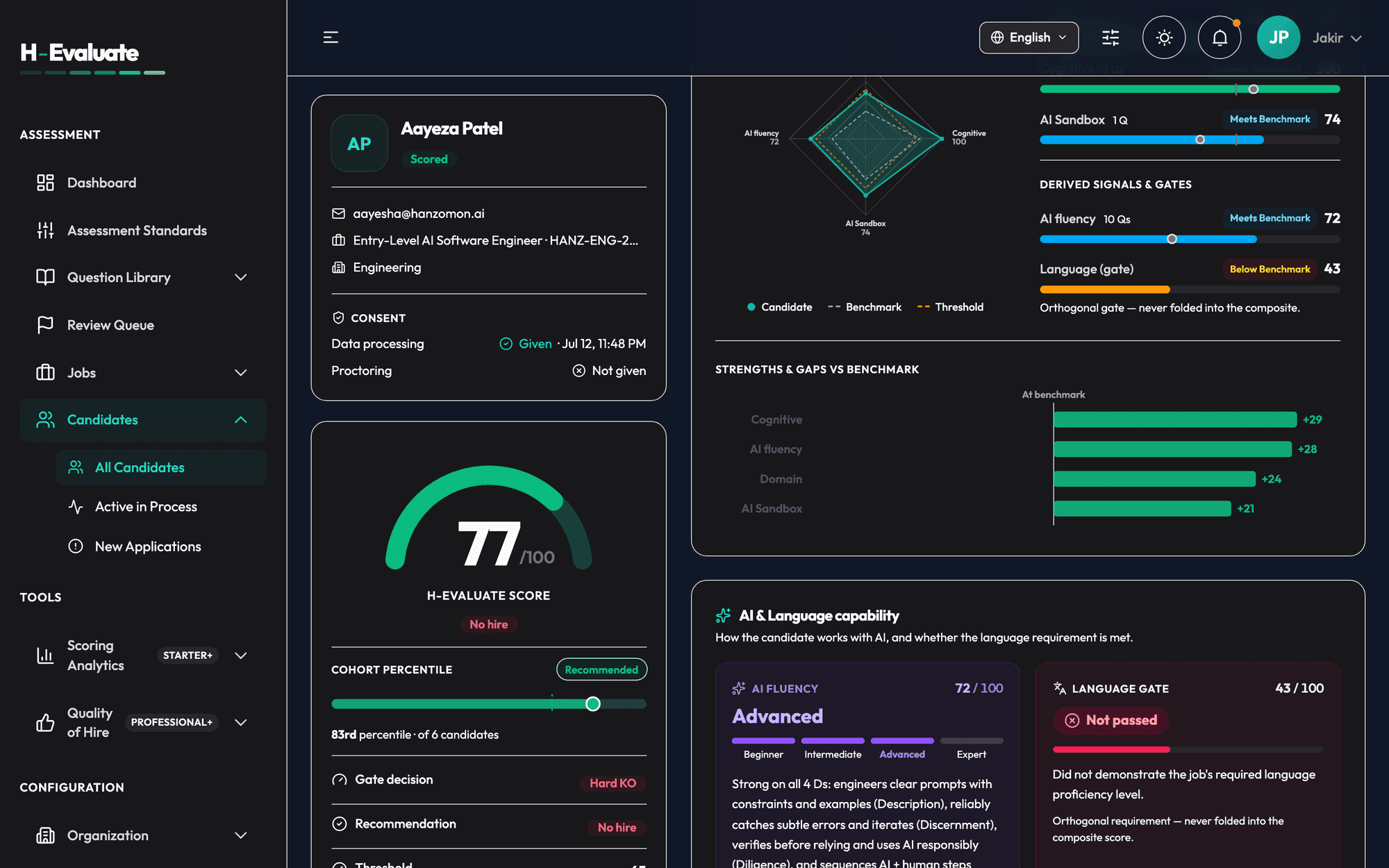
The single most important thing you can do to reduce the fairness risk of cognitive testing is to stop letting it decide alone. A high score is a strong hypothesis about ceiling and ramp-up, not a hire — and a middling score sitting next to strong domain skill evidence should be read as a whole, not as a failed hurdle. When cognition is one weighted input alongside domain, situational judgement, behavioural signals and AI Fluency, no candidate is rejected on one narrow measure before anyone has seen what they can do.
The weighting itself should be a deliberate, per-role decision rather than a company default. Reasoning matters more for complex, ambiguous work than for well-defined, procedural tasks — a lever most teams ignore. A useful test is to ask how much of the role's value comes from figuring out things nobody has written down yet. Weight the pillar to match, write the weighting down so it can be reviewed, and keep it out of the very top of the funnel where it does the most damage to pipeline diversity and gives you the least context to read a borderline score. The same point holds across structured hiring: define the standard in advance, apply it identically, and never let one stage carry the whole decision.
Condition three: verify with monitoring, do not assume
The quiet failure mode of structured hiring is assuming that because you added a standardised test and a rubric, the outcomes must be fair. They might not be. A stage can be perfectly consistent and still produce adverse impact — and with cognitive testing, given its documented history, the probability is high enough that assuming fairness is negligence, not optimism. The only honest claim about a cognitive stage is one you have measured.
Monitoring is the four-fifths rule applied continuously: at every stage where a cognitive score influences the cut, compare each group's selection rate against the highest group's. If any falls below 80%, that is a flag to investigate job-relatedness — not a verdict of discrimination, but a prompt you cannot ignore. Run it per stage and per role, because an end-to-end number can look balanced while one step does the damage, and re-check it as your applicant pool shifts. Fairness you cannot evidence is fairness you cannot defend.
Instrument the highest-volume stage first. If a cognitive score sits early in a high-applicant funnel, it affects more people than every downstream stage combined — so that is where an unmonitored adverse-impact problem does the most damage before anyone notices.
Treat small samples with particular care. When a group has too few candidates for the ratio to be stable, resist both reflexes: dismissing a breach as noise and treating it as proof. Note it, watch whether it persists as numbers grow, and pair the raw ratio with a sense of statistical significance. Over-reacting to small-sample swings burns credibility; ignoring a persistent pattern because 'the numbers are small' is how a real problem hides in plain sight.
Holding both facts at once
The credible position on cognitive assessment is not comfortable, and it should not be. Cognitive tests reduce bias relative to unstructured judgement of who seems clever — because they give every candidate the same evidence, scored the same way, instead of an impression soaked in background. And cognitive tests carry the sharpest documented fairness risk of any pillar, which is why they must be calibrated to the job, capped to one signal among five, and audited continuously. A post that only tells you the first half is selling something; one that only tells you the second half is giving up a genuinely useful signal for fear of using it well.
What makes the difference is discipline, not virtue. You do not reduce the bias risk of cognitive testing by believing harder that your test is fair. You reduce it by tying it to the work, refusing to let it stand alone, and reading your own adverse-impact numbers rather than a general theory of fairness. The teams that run that loop a few times learn more about where their bias actually lives than any assurance could teach them — because they are looking at outcomes, not intentions.
Where H-Evaluate fits
H-Evaluate is an AI-native skills assessment platform built to make each of those three conditions the default rather than an act of will. Cognitive items are generated per job so they map to the reasoning the role actually demands, and every item passes a quality gate before a candidate sees it. The score arrives as one weighted input in a full candidate evaluation — sitting next to domain, situational, behavioural and AI Fluency evidence, already weighted for the role — rather than as a solitary verdict on a spreadsheet. That framing changes behaviour: a recruiter reading a whole evaluation is far less likely to reject a strong candidate on a middling reasoning score.
Because the platform is compliance-first, the adverse-impact view is part of the product, not a report you assemble under deadline. Selection data is captured per role and per stage, so four-fifths monitoring is a by-product of how you hire. None of that removes your obligation to run the analysis and confirm requirements with counsel — no tool can. What an AI-native platform can do is make the evidence a standing by-product of the process, so the honest, comparative claim about cognitive assessment is one you can actually back up.
A cognitive test does not make hiring fair. It makes one signal comparable — and then hands you the responsibility to weight it honestly and measure what it does to the people you turn away.
Written by
Aayesha Patel · Co-founder, Hanzomon Inc
Co-founder of Hanzomon. Writes about skills-based hiring, fair assessment and building a better candidate experience.