Hiring · July 30, 2026 · 9 min read
Do situational judgement tests reduce hiring bias?
Situational judgement tests replace 'culture fit' gut calls with standardised scenarios scored on reasoning. How they reduce hiring bias, and their own risks.
← Part of The five pillars of hiring: what assessments measure
On this page
- Why 'culture fit' is a bias vector, not a signal
- How scenarios take gut feel out of the decision
- The honest part: how a scenario can encode bias
- Three mitigations that keep the test measuring judgement
- Build scenarios from real incidents
- Score the reasoning, not the etiquette
- Review items across a reviewer panel
- Reducing bias is not the same as proving it
- Where situational judgement sits in a fair process
- Where H-Evaluate fits
'Culture fit' is where a carefully structured hiring process quietly hands the decision back to gut feel. This is for hiring managers and talent leaders who want to know whether situational judgement tests reduce bias in hiring — and the honest answer is that they can, but only in a specific way and only if you build them with their own failure modes in mind. The reason to care is that the 'culture fit' call is one of the most reliable bias vectors we have: it feels like discernment and behaves like familiarity, and it does its damage in interviewers who are certain they are being fair.
The claim worth making is narrow and defensible. Standardised, job-relevant situational judgement tests reduce bias relative to unstructured interviews and 'culture fit' gut calls, because they give bias fewer places to operate — the same scenarios for every candidate, scored against the same rubric, with adverse-impact monitoring to verify the result rather than assume it. No assessment eliminates bias. This is a companion to our guide to reducing bias in hiring; here we look specifically at what the situational judgement pillar does to bias, and where it can introduce bias of its own.
Why 'culture fit' is a bias vector, not a signal
Start with what 'culture fit' actually measures in most rooms. Asked to justify it, interviewers reach for words like 'energy', 'chemistry', or 'someone I'd want to grab a coffee with'. None of those describe the job. What they describe is recognition — the comfortable sense that a candidate resembles people who have succeeded here before, which usually means people who resemble the interviewer. That recognition arrives fast, before any evidence about competence, and it is nearly impossible to talk yourself out of in real time.
This is the classic mechanism of hiring bias: an unstructured decision made from an impression, where familiarity is mistaken for merit. A candidate who shares your school, your accent, or your way of framing a problem registers as 'a safe pair of hands' before you have examined a single decision they have made. The interview then rationalises the feeling. 'Culture fit' is dangerous precisely because it launders that first impression into something that sounds like a considered judgement about values.
'Culture fit' usually means 'culture same'. It rewards candidates who feel familiar, which correlates with background far more than with competence — and it does so in interviewers who sincerely believe they are being fair.
The point is not to stop caring about values or how someone works. It is to stop assessing them by feel. Replace the affinity call with a defined standard applied identically, and you have converted a bias vector into an evaluable one. That is what a well-built situational judgement test does: it takes the messy human question 'would this person handle our situations well?' and turns it into the same scenario, put to every candidate, scored on the same rubric.
How scenarios take gut feel out of the decision
A situational judgement test puts a candidate inside a realistic dilemma and scores how they reason through it — what they prioritise, when they escalate, which trade-offs they accept. Because there is rarely a single correct answer, the signal is the reasoning, not a lucky guess. Our deep dive on situational judgement covers the mechanics of designing and scoring scenarios; the bias story is what happens to the decision once you do.
Three things change when you replace the 'culture fit' chat with a scored scenario. Every candidate meets the same evidence, so nobody advances on rapport while someone equally capable is quietly marked down for being harder to warm to. The rubric defines what strong, adequate and weak reasoning looks like in advance, so the standard exists before the candidate does — it cannot be bent to fit the person you already liked. And the result is recorded, which means a rejection can be explained against a scenario and a rubric rather than asserted as a feeling. This is the same anchoring discipline that makes structured interviews fairer than free-flowing ones; situational judgement applies it to decisions rather than to traits.
There is a research context worth stating carefully, because it is easy to overclaim. Industrial psychology research generally associates situational judgement tests with smaller group differences than cognitive ability tests, while still predicting performance. That is a qualitative tendency reported across the literature, not a promise about your particular test on your particular pool. It is one reason the pillar earns real weight in a balanced model — but it is a starting position, not a clean bill of health, and it never substitutes for measuring your own outcomes.
The comparison to cognitive tests is directional, not absolute. 'Generally smaller group differences' describes a research tendency, not a guarantee for your test — which is why monitoring stays part of the answer regardless.
The honest part: how a scenario can encode bias
A series about bias that only listed a method's virtues would not be worth reading. Situational judgement has a real, specific failure mode, and it is subtle: a scenario can quietly encode one culture's idea of the 'right' answer. The people who write the item bring their own norms about directness, deference, how quickly you should escalate, when it is appropriate to challenge a senior stakeholder, how much you apologise. If those norms slip into the rubric as the 'correct' response, the test stops measuring judgement and starts measuring whether a candidate shares the author's etiquette.
Consider a scenario where a junior engineer spots a flaw in a director's plan an hour before a launch. One reviewer's 'obviously right' answer is to raise it immediately and directly in the group channel. Another equally sound candidate, reasoning from a different professional culture, would flag it privately to their lead first and let them carry it up. Both are defensible. Both show good escalation judgement. If the rubric only credits the direct-and-public route, the item is no longer scoring reasoning — it is scoring assertiveness norms, and it will systematically penalise candidates whose sound judgement expresses itself differently.
This is the etiquette-scoring trap, and it is easy to fall into because the encoded norm feels like plain common sense to the person who holds it. Left unchecked, a situational judgement test can reintroduce exactly the familiarity bias it was meant to remove — just laundered through a rubric, which makes it look objective and therefore harder to challenge. A biased scenario is more dangerous than a biased interviewer, because it applies the same skew to every candidate consistently and calls the consistency fairness.
Watch for etiquette masquerading as judgement. If a rubric credits a single 'right' way to raise a concern, escalate, or challenge authority, it is scoring cultural norms, not reasoning — and it will penalise candidates who reach an equally sound answer by a different route.
Three mitigations that keep the test measuring judgement
The failure mode is real, but it is designable-against. Three disciplines do most of the work, and none of them requires a research team.
Build scenarios from real incidents
The best scenarios are remembered, not invented. An item written from scratch tends to smuggle in the author's assumptions about how a good employee behaves; an item built from a hard week the team actually lived through carries the genuine tension instead of a scriptwriter's stereotype. Start from a post-incident review or a decision that split the room, strip the identifying detail, and stop the narrative at the moment of choice. Real incidents also resist the tidy, one-culture 'correct' answer, because real situations rarely had one.
Score the reasoning, not the etiquette
This is the load-bearing mitigation. The rubric should credit the quality of the reasoning — did the candidate name the trade-off, sequence the response sensibly, know when the decision was above their pay grade, act on the information they had? — and stay silent on surface style. Two candidates who reach a sound outcome by different routes should score alike; a candidate who picks the 'preferred' option for a reckless reason should not be rescued by the choice. Anchoring the rubric to reasoning is what stops it drifting into a test of manners.
Review items across a reviewer panel
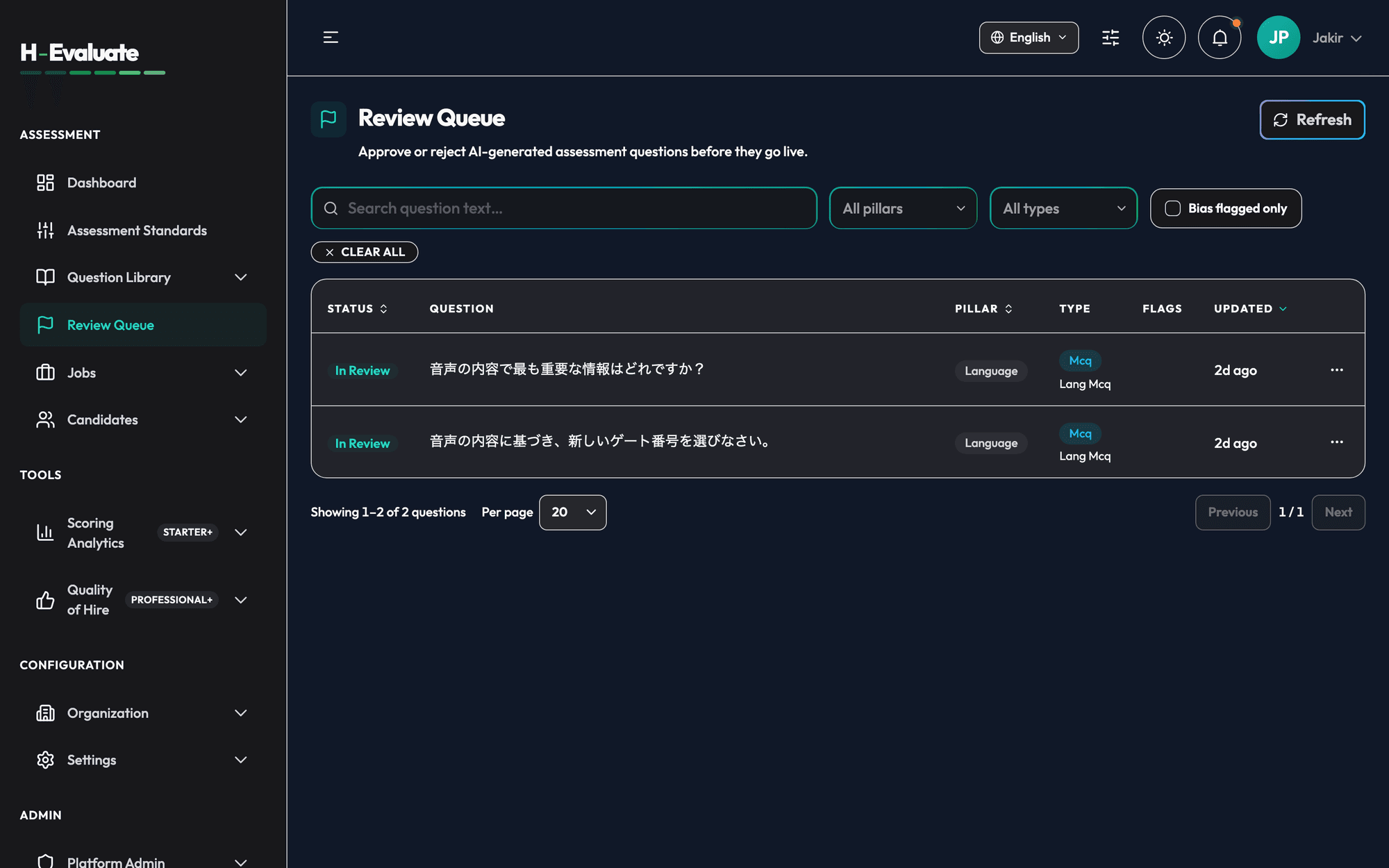
An encoded assumption is invisible to the person who holds it, which is why a single author is the wrong unit of review. Put every scenario and its rubric in front of a panel of reviewers from different backgrounds and roles, and ask a blunt question: is there a defensible answer this rubric would unfairly mark down? If two strong reviewers disagree on the 'right' response, you have either found a genuinely rich scenario or an encoded norm — and either way the rubric needs to credit both routes to a sound decision. A human review queue is the natural place for this to live as a standing step, not a one-off launch check.
Reducing bias is not the same as proving it
Every mitigation above is design work — it gives bias fewer places to enter. None of it tells you whether the result is actually fair on your pool. That is the job of measurement, and it is non-negotiable regardless of how favourable a method's research starting position looks. Track selection rates by group at the situational judgement stage, apply the four-fifths rule, and treat any flag as a reason to investigate the item rather than a verdict on it.
The quiet failure mode of structured hiring is assuming that because you added a rubric, the outcome must be fair. It might not be. A scenario can be scored with perfect consistency and still encode a norm that skews results, and only outcome data will tell you. The 'generally smaller group differences' research finding makes this trap more tempting, not less — it is exactly the kind of comfortable prior that stops teams from checking. A compliance-first process treats monitoring as part of how you hire, not an audit you run under deadline. This is the same logic that runs through our guide to reducing bias in hiring: design to reduce, measure to confirm.
Do not let a favourable research finding replace your own data. 'Smaller group differences on average' is a reason to weight the pillar, not a reason to skip measuring selection rates on your actual candidates.
Where situational judgement sits in a fair process
No single pillar carries fairness alone. Situational judgement covers the decision-making that cognitive and domain tests leave untouched, and it does so from a comparatively favourable position on group differences — which is why it belongs in a balanced model rather than as a standalone gate. Any assessment used as the sole filter concentrates its own biases; used as one signal among several, each pillar's weakness is diluted by the others' strengths. Situational judgement pairs naturally with work-sample tests and skills-based screening, which move the first real signal from pedigree to demonstrated ability.
The through-line across the whole approach is consistent: replace impressions with the same evidence for every candidate, evaluated against the same standard, and verify the outcome with monitoring rather than trusting your intentions. Situational judgement is a strong contributor to that because it retires one of hiring's worst habits — the 'culture fit' gut call — and replaces it with something you can score, explain and audit. That is a genuine reduction in bias. It is not an elimination of it, and any post that told you otherwise would be selling.
Where H-Evaluate fits
H-Evaluate is an AI-native skills assessment platform, and situational is one of the five pillars it evaluates. Situational judgement is delivered through realistic, role-specific scenarios — often as a work-sample session in the AI Sandbox — where candidates reason through a decision rather than pick from a canned list. AI-generated assessments are built per job, so scenarios reflect the dilemmas the actual role produces rather than a generic template, and generation freshness means candidates rarely meet a scenario that has already leaked to an answer site.
Responses are scored against a consistent rubric anchored to the reasoning, and a human review queue lets a panel vet scenarios before they reach candidates — the practical home for the panel-review discipline above. Selection data is captured per role and per stage, so adverse-impact monitoring is a by-product of how you hire rather than a project you run before an audit. To see a situational round sit alongside the other pillars, book a demo or work through a sample assessment yourself.
A situational judgement test does not remove bias by being objective. It removes bias by making the standard explicit, the same for everyone, and open to challenge — which is the opposite of a 'culture fit' gut call.
Written by
Aayesha Patel · Co-founder, Hanzomon Inc
Co-founder of Hanzomon. Writes about skills-based hiring, fair assessment and building a better candidate experience.