Hiring · August 2, 2026 · 10 min read
Operations analyst job description template (free, 2026)
An operations analyst job description template to copy and adapt: responsibilities, requirements, and the AI-fluency section rival templates leave out.
← Part of The pillars of hiring: what assessments measure
On this page
This template is for the operations lead, the founder wearing the ops hat, or the recruiter briefed to fill an operations analyst role — the person who will hand someone a broken process and expect a fix that sticks. In one concrete breath: an operations analyst maps how work actually runs, finds where it leaks time or money, and hands an operator a change they can ship on Monday. The job description is hard to write because the title spans wildly different jobs — a reporting analyst, a process-improvement analyst, and a business-operations strategist all answer the same advert — and because the market is drowning in boilerplate that lists tools nobody diagnoses with. The role sits between the data team and the operators, reporting into operations, finance, or a chief of staff depending on the company. Below is a copy-paste template, plus the sections every rival leaves out — starting with the one nobody writes at all: what you expect from this person when they work with AI.
The operations analyst job description template
Copy the sections below, delete what does not apply, and fill the [bracketed placeholders]. Every bullet is written to be observable — something you could later assess against, not a vague wish. That is the point: a job description should read like a spec you can test a candidate against, not a mood board.
About the role
[Company] is hiring an operations analyst to [own the reporting and diagnosis of one or two core processes, e.g. the fulfilment queue and the refund workflow]. You will work alongside [the operations, finance, and support teams] to find where work slows, quantify the cost, and propose fixes an operator can actually run. This is a hands-on role for someone who is as comfortable mapping a messy workflow as they are pulling and cleaning the data behind it.
Responsibilities
- Map how a core process really works — the workarounds and exceptions people use, not the flowchart in the wiki.
- Pull and clean your own data in [SQL / the data warehouse / spreadsheets] rather than queuing every request behind the data team.
- Diagnose the true bottleneck in a process, separating the symptom from the cause, and quantify what it costs in time or money.
- Build and maintain the reporting that [operations / leadership] relies on, and retire the reports nobody reads.
- Propose fixes an operator can ship, with a sense of effort, cost, and second-order effects.
- Use AI tools to draft and accelerate analyses, then check that output before it informs a decision.
- Communicate findings so a busy, sometimes sceptical team actually adopts the change.
- Track whether a shipped fix worked, and close the loop with a before-and-after the team can see.
- Partner with [finance / support / the data team] to make sure the numbers you report reconcile with theirs.
Requirements
- Demonstrated experience diagnosing and improving a real business process, with a result you can describe concretely.
- Data literacy: comfortable pulling and cleaning your own data in [SQL and spreadsheets], and honest about what the numbers can and cannot say.
- Structured problem-solving — turning a vague 'this is slow' into testable hypotheses rather than a favourite conclusion.
- Judgement about what to measure, and the discipline to ignore vanity metrics that flatter more than they inform.
- Clear written and spoken communication that moves a decision, not just a chart that gets admired and filed.
- The pragmatism to ship an 80%-right answer this week when a perfect one next quarter helps no one.
- Ability to work across [operations, finance, and support] and translate between their languages.
Nice to have
- Experience in [our sector, e.g. logistics, fintech, marketplace operations] and its typical failure modes.
- Familiarity with [our stack: the specific warehouse, BI, or workflow tools] — but the thinking matters more than the toolset.
- Exposure to process-improvement methods (lean, Six Sigma) without treating them as a substitute for judgement.
- A track record of getting a sceptical team to adopt a change they did not ask for.
AI fluency expectations
The day-to-day of this role is now saturated with AI-drafted analyses. We expect an operations analyst to work with AI fluently and sceptically:
- Judge AI-drafted analyses before forwarding them — reading a generated summary or query critically rather than pasting it into a deck untouched.
- Keep prompt hygiene with business data: never pasting confidential or personal data into tools that do not permit it, and knowing what is safe to share.
- Work fluently across the spreadsheet-plus-AI workflow — delegating the boilerplate query or first-pass cleaning, keeping the judgement calls.
- Know when a number needs a human check: recognising the confident-but-wrong output before a recommendation rides on it.
- Explain, when asked, where AI helped and where it was caught being wrong — because the verification is the skill, not the speed.
That AI fluency section is the part no rival template includes. We checked the ranking operations analyst job descriptions in mid-2026: not one writes AI expectations into the role, even though the actual work is already full of AI-drafted analyses. Leaving it out does not make the AI go away — it just means you never told the candidate you expect them to check it.
What we offer
[A short, honest paragraph: the compensation band, the working pattern (remote / hybrid / on-site), the team the analyst joins, and what the first six months looks like — a queue cleared, a report retired, a cost curve bent.] We would rather tell you the real first project than promise a culture of excellence. [Add benefits and location as they apply.]
How do you adapt this template?
Pick a lane first. The title spans a reporting analyst, a process-improvement analyst, and a business-operations strategist, and the same advert cannot recruit all three. Decide which one you actually need, then dial the seniority and cut the requirements that describe a different job. A vague advert produces vague candidates.
For a startup, keep the scope narrow and the seniority honest: one person who can pull their own data and ship a fix beats a strategist with no one to execute. Widen the responsibilities but drop the tool specifics — you want range, not a Tableau certificate. For an enterprise, the opposite: name the systems, the reporting cadence, and the stakeholders, because the friction is coordination, not capability. A reporting-heavy role leans on the data-literacy and communication bullets; a process-improvement role leans on the diagnosis and change-management bullets; a business-operations strategist role needs the judgement and cross-functional bullets promoted to the top and the hands-on data work relaxed.
The bullets people wrongly copy from legacy job descriptions are the ones to delete. A degree requirement filters on credential, not on whether someone can find your leak — and it narrows the pool while importing bias. 'Five years with [named tool]' filters on tenure with software that changes quarterly. And the endless list of BI tools screens for exposure, not diagnosis. If you would not test for it, do not require it. The companion how to hire an operations analyst walks the full process this template feeds into, from scoping to the debrief.
The single most common mistake is writing one advert for three jobs. If your responsibilities list mixes 'build the weekly dashboard' with 'redesign the fulfilment process' with 'model the unit economics for the board', you have not written a job description — you have written a shortlist of roles you have not decided between. Split it, or you will interview candidates who are each strong at a third of the job.
What should you assess instead of trusting the CV?
A CV tells you where someone has been, not whether they can find your leak. Assess the requirements directly, and map each to what a fair evaluation can actually measure — the four scored pillars of candidate evaluation (cognitive, domain, situational judgement, and behavioural), plus AI fluency as a requirement check you set rather than a scored pillar. Read them capability-level in the pillars of hiring.
- Domain — data literacy and process diagnosis, tested inside a job-shaped work sample test: a messy process description and a slice of data, with a bottleneck to find and a fix to propose.
- Cognitive — structured problem-solving, seen in how they break 'this is slow' into hypotheses rather than jumping to a conclusion.
- Situational judgement — what they choose to measure and what they ignore, and how they reason when the data is ambiguous.
- Behavioural — the communication and persistence that gets a sceptical team to adopt a change.
- AI fluency (requirement check) — whether they delegate the grunt query to AI but catch it when a generated answer is confidently wrong about the workflow.
Scored
Checked, never scored
Language
Pass/fail. Below the level you set, the candidate doesn't advance.
AI fluency
Below the minimum, a passing candidate goes to human review.
The scored pillars, weighted to the role (plus the AI Sandbox if enabled), make up the score. Requirement checks sit outside it.
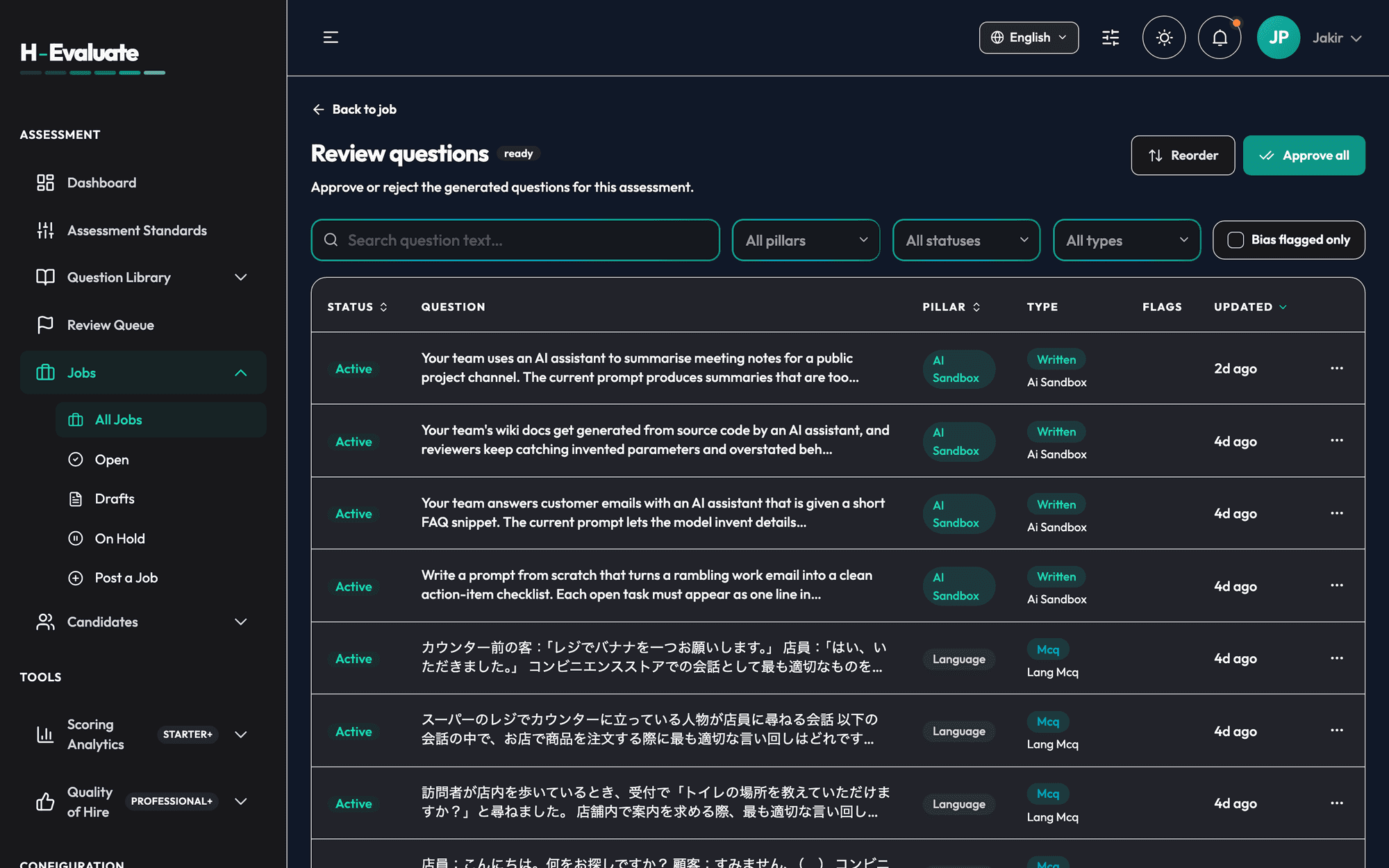
The work sample does most of the work: an exercise that mirrors the job so closely that doing well on it and doing well in the role are nearly the same thing. Then use a structured interview — same questions, same order, same rubric — to probe the judgement a work sample cannot fully surface. For AI fluency specifically, watch the work rather than asking about it; how to assess AI fluency explains reading the signals, and prompt engineering for data analysts is worth sharing with the person who ends up doing this job. This is what an AI-native skills assessment platform is built to do — you can see a live version in the product demo or run a short sample assessment yourself. Assess the diagnosis-and-fix, not the toolkit.
Why is this title so easy to fake on a CV?
Because 'operations analyst' means three different jobs, a candidate can borrow a team's win from any of them and present it as their own. The reporting analyst who maintained someone else's dashboard, the strategist who sat in the meeting where the fix was decided, the process-improvement analyst who ran the workshop but did not do the diagnosis — all three write the same tidy bullet: 'reduced fulfilment time by 30%.' The CV cannot tell you who actually did the diagnosis, and the AI-drafted CV now makes every one of those bullets read equally polished.
So watch for the red flags an application throws off. A wall of tool logos with no story about a process fixed. Numbers with no method — a percentage improvement and no account of how the bottleneck was found. Answers that stay at the level of 'the team' and never resolve to 'I'. And, increasingly, a suspiciously fluent covering letter that collapses the moment you ask a specific follow-up — a sign the analysis you are reading was drafted by a tool the candidate did not check. None of these are disqualifying alone; together they tell you to lean on the work sample and stop trusting the narrative.
You may not need this role yet. If your processes are still small enough that the person running them can also spot where they break, an operations analyst is a hire in search of a problem. Wait until you have a workflow big enough to leak money quietly — a queue nobody owns, a report that drives a decision no one has checked — and then hire someone to find it. Creating the role before the leak exists just gives you dashboards nobody acts on.
A job description is the first assessment you write. If the responsibilities are observable and the requirements are things you would actually test, the advert filters honestly before a single candidate applies — and the AI-fluency section you added tells them, unlike every rival template, exactly the kind of judgement you expect when the analysis is half-written by a machine.
Written by
Aayesha Patel · Co-founder, Hanzomon Inc
Co-founder of Hanzomon. Writes about skills-based hiring, fair assessment and building a better candidate experience.